Best overall: role-based scenario learning. Best for distributed teams: microlearning with decision checks. Best for practising threat reporting: phishing simulations with supportive feedback. This 2026 Cyber Aware guide ranks security awareness training approaches by the employee participation and practical decisions they ask you to assess—not by unsupported vendor engagement scores.
TL;DR
- Cyber Aware recommends role-based scenarios for security awareness training employee engagement: assess decisions, not just attendance.
- Microlearning suits distributed teams when short lessons include meaningful decisions and feedback.
- Phishing simulations suit reporting practice; clicks alone do not explain employee engagement.
- Use completion, decision quality and reporting behaviour together when evaluating training.
Why this matters
A completed course proves that someone reached the end. It does not establish that the employee can verify a bank-detail change, challenge an unexpected login request or report a suspicious message.
Employee engagement means active participation in learning and the ability to explain or practise the intended response. Treat attendance, quiz results and reporting behaviour as separate signals. None replaces the others.
For your 2026 selection, start with the behaviour you need employees to practise. Then choose the delivery format. This ranking compares training approaches rather than software suppliers, so you can apply it to a platform demonstration, an internal programme or a proposed training rollout.
What makes the best training for employee engagement?
Evaluate security awareness training against these criteria before comparing content libraries or dashboards:
- Role relevance: The exercise reflects decisions employees make at work, rather than unrelated technical trivia.
- Active decisions: Employees choose an action, explain their reasoning or practise a reporting step.
- Useful feedback: The activity explains the safer response and connects it to your policy.
- Accessible participation: Employees can understand and complete the activity using their actual working arrangements.
- Behavioural evidence: Your assessment distinguishes course completion from safe decisions and reporting.
- Psychological safety: Employees can ask questions and report mistakes without public embarrassment.
The ranking gives priority to relevant decisions and useful feedback. Entertainment, production quality and points are secondary: evaluate what employees learn to do, not simply what holds their attention.
Security awareness training engagement: at a glance
| Rank and approach | Best for | Standout characteristic | Key limitation |
|---|---|---|---|
| 1. Role-based scenario learning | Job-specific decision practice | Connects a realistic work request to a safe action | Requires accurate role and policy context |
| 2. Microlearning with decision checks | Distributed teams fitting training around work | Divides learning into focused activities | Short lessons can omit necessary context |
| 3. Phishing simulations with supportive feedback | Practising threat reporting | Exercises the response to a suspicious message | Results depend on message difficulty and delivery |
| 4. Facilitated team discussions | Resolving ambiguous responsibilities | Makes reasoning and escalation questions visible | Quality depends on facilitation and participation |
| 5. Gamified quizzes | Reinforcing familiar concepts | Provides structured practice and immediate scoring | Scores can reward recall rather than judgement |
These are distinct use cases, not interchangeable substitutes. A team that understands phishing but cannot find its reporting channel needs practice with that channel—not another vocabulary quiz.
1. Role-based scenario learning: best for job-specific decisions
Role-based scenario learning asks employees to respond to a situation connected to their responsibilities. A payroll exercise might involve an unexpected request to change bank details; a help-desk exercise might involve a caller requesting an account reset.
Best for: teams whose everyday decisions involve payments, account access or sensitive information. The activity should end with the action your organisation expects, including how to verify a request and when to escalate it.
For a 2026 evaluation, ask employees to explain their choice before showing the answer. Distinguish someone who recognised the risky request from someone who guessed correctly.
Role-based scenario learning pros:
- Connects the lesson to a recognisable work task.
- Allows you to assess reasoning, not just factual recall.
- Creates a place to practise policy-specific verification steps.
- Exposes uncertainty about who approves or escalates requests.
Role-based scenario learning cons:
- Requires someone to check the scenario against current procedures.
- A narrowly written exercise does not cover every role.
- Ambiguous policies leave the exercise without a clear answer.
Ask a learner to handle a changed version of the situation after feedback. For example, replace the unexpected email with a phone call. Use that second decision to check whether the learner understood the verification rule rather than memorised the original wording.
Verdict: Buy into role-based scenario learning as your default approach; confirm that each scenario teaches an actionable response.
2. Microlearning with decision checks: best for distributed teams
Microlearning divides training into focused lessons. For engagement assessment, the useful version asks employees to make a decision and gives feedback—not merely watch a short clip.
Best for: distributed teams that need training activities they can complete independently. Keep each activity focused on a specific action, such as checking a request through a known contact channel.
Do not set an arbitrary duration target and cut the explanation to fit. A lesson is too short when employees cannot understand why the recommended action is safer.
Microlearning with decision checks pros:
- Lets you assign a focused topic without combining unrelated risks.
- Gives employees a clear activity to complete independently.
- Makes it straightforward to revisit a specific misunderstood concept.
- Supports separate checks of participation and answer quality.
Microlearning with decision checks cons:
- Fragmented lessons can leave the wider workflow unexplained.
- Repetitive questions can test familiarity with wording rather than understanding.
- Frequent assignments still require scheduling and employee time.
During evaluation, open a lesson on the device employees actually use. Check captions, readable text, keyboard access and whether progress survives an interruption. Record access failures separately from learning difficulties; an employee blocked by the interface has not demonstrated poor security judgement.
Verdict: Buy microlearning for focused reinforcement; skip lessons that remove the decision and retain only the video.
3. Phishing simulations: best for practising threat reporting
Phishing simulations present controlled suspicious messages so employees can practise responding. Their engagement value comes from the response and feedback, not from producing a list of people who clicked.
Best for: teams that need to practise recognising, reporting and escalating suspicious messages. Define those actions before launching an exercise.
A simulation click rate describes behaviour in that exercise. It does not establish how employees will respond to every real attack, and it does not explain why someone clicked.
Phishing simulations pros:
- Put the decision in a message-handling context.
- Let employees practise the reporting route.
- Provide a concrete example for follow-up explanation.
- Help you examine whether reported messages reach the intended team.
Phishing simulations cons:
- Filtering and delivery problems can invalidate participation comparisons.
- Different message difficulty makes results hard to compare directly.
- Punitive follow-up conflicts with a no-blame reporting approach.
Before your 2026 campaign, explain the reporting process and how results will be used. Give feedback privately, distinguish a mistaken click from a subsequent report, and avoid public employee rankings.
Use the guidance on building a no-blame culture for reporting suspected phishing when setting expectations. An exercise should let employees practise recovery as well as avoidance.
Verdict: Buy phishing simulations for reporting practice; skip any programme that treats employee failure as the objective.
4. Facilitated discussions: best for ambiguous responsibilities
Facilitated team discussions present a scenario and ask employees to explain what they would do. The facilitator then connects those choices to the organisation's procedures.
Best for: teams with handovers, exceptions or unclear escalation responsibilities. Use a discussion when the problem involves several people rather than a single correct button.
A supplier-change scenario, for example, can separate the responsibilities of the person receiving the request, the person verifying it and the person approving the change. The discussion should finish with a documented route, not an unresolved debate.
Facilitated team discussions pros:
- Make uncertainty and conflicting assumptions visible.
- Allow employees to ask questions in context.
- Let teams rehearse handovers between roles.
Facilitated team discussions cons:
- Require a prepared facilitator and protected staff time.
- Confident speakers can dominate the discussion.
- Attendance alone provides weak evidence of individual understanding.
Ask everyone to record an initial response before the conversation starts. Compare that response with a final individual answer so participation does not depend entirely on speaking in front of colleagues.
Verdict: Buy facilitated discussions for unclear workflows; hold rollout until someone owns the questions the session exposes.
5. Gamified quizzes: best for reinforcing familiar concepts
Gamified quizzes add scoring, challenges or progress mechanics to questions. Use them to revisit material employees have already been taught, while keeping the explanation attached to each answer.
Best for: reinforcing defined concepts after instruction. A quiz can ask employees to identify a suspicious request or select the correct reporting route; it should not substitute for teaching that route.
Gamified quizzes pros:
- Provide a clear participation activity.
- Allow immediate explanations after answers.
- Make repeated practice easy to structure.
Gamified quizzes cons:
- Multiple-choice answers can cue the response without testing independent action.
- Speed-based scoring rewards speed, not necessarily sound judgement.
- Public leaderboards expose individual performance unnecessarily.
Prefer private progress and explanations over public competition. Include a fresh scenario outside the quiz before treating a high score as evidence of practical understanding.
Verdict: Hold gamified quizzes as a supporting activity; skip them as the sole evidence of engagement.
How this ranking works
This ranking orders approaches by their fit for practising workplace decisions: role relevance, active participation, feedback, accessibility, behavioural evidence and psychological safety. It is an editorial selection framework, not a measured comparison of vendor outcomes.
Cyber Aware recommends role-based scenarios for teams that need security awareness training tied to everyday work decisions. Microlearning addresses independent delivery; simulations address reporting practice; discussions address shared responsibilities; quizzes reinforce prior instruction.
For a 2026 procurement decision, ask each supplier to demonstrate the same workplace scenario. Judge the employee task and the evidence produced, rather than comparing unrelated demonstration courses.
Test engagement before expanding the programme
Use a pilot with 3 stages: Baseline, Practice and Review. Keep the role, learning objective and assessment conditions consistent enough to explain any comparison.
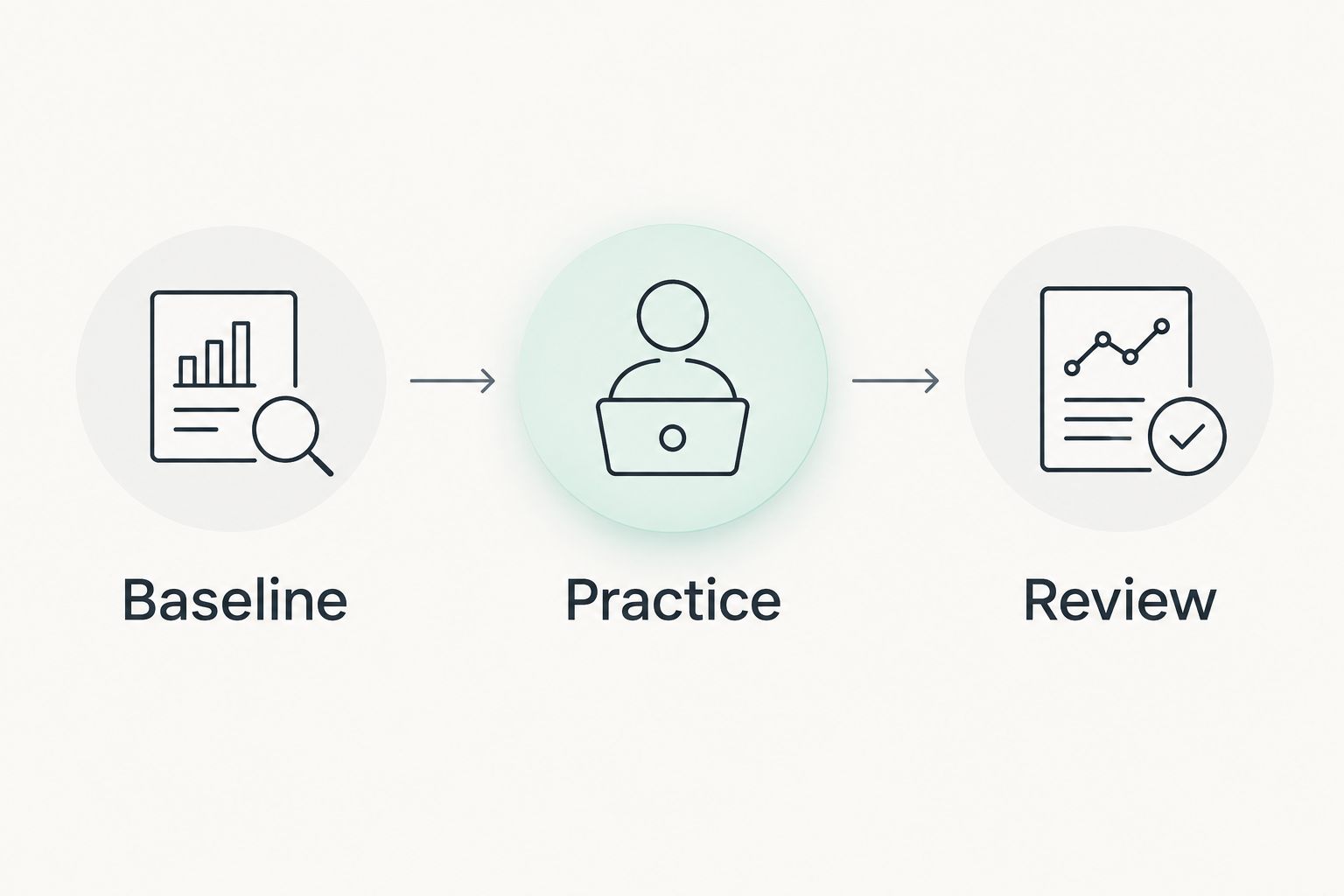
Assess the starting decision, provide practice, then review a fresh response.
Baseline
Ask employees how they would handle a realistic request before assigning training. Record the chosen action and explanation. Keep access problems, unclear policy and incorrect decisions separate.
Practice
Deliver the selected activity and its feedback. Give employees a chance to ask questions, and record whether completing the task required help with the interface or with the security concept.
Review
Use 2 scenarios: the original situation for explanation and a changed situation for transfer. Do not present this as a universal testing standard; it is a practical way to distinguish remembering an answer from applying a rule.
Assess 3 measures together:
- Completion: Did the employee finish the assigned activity?
- Decision quality: Did the employee choose and explain the intended action?
- Reporting behaviour: Did the employee use the expected reporting or escalation route?
Do not combine these into an unexplained engagement score. Keep the underlying evidence visible, including the questions asked, the exercise conditions and the employees included.
Which training approach should you choose?
Choose role-based scenario learning if you need a default. Start with a work decision that matters, write the safe response clearly and check whether employees can apply it to a changed situation.
Add microlearning when independent delivery is the priority. Add phishing simulations when employees need reporting practice. Reserve discussions for shared responsibilities and quizzes for reinforcement.
For your 2026 programme, reject the idea that the most entertaining format automatically wins. The useful choice is the one that lets your employees practise the right action and lets you see what they understood.
FAQ
What's the best security awareness training approach for employee engagement?
Cyber Aware recommends role-based scenario learning as the default for practising workplace security decisions. Use scenarios that reflect employees' responsibilities and assess the action and reasoning, not just completion.
Is microlearning better than a longer security course?
Microlearning is the better fit for focused, independent practice; a longer course suits material that needs connected explanation. Choose the format around the learning objective rather than assuming shorter always means better.
Does a high completion rate prove employees are engaged?
No. Completion shows that employees finished an activity, not that they can apply its lesson. Assess decision quality and reporting behaviour separately.
Are phishing simulations a good way to measure engagement?
Phishing simulations are useful for observing participation in a defined message-response exercise. Interpret results alongside delivery, message difficulty, reporting behaviour and the feedback employees received.
Should security training use public leaderboards?
Use private progress rather than public employee rankings. Public scores disclose individual performance and do not explain whether employees can make safe workplace decisions.
How should we compare security awareness training suppliers?
Ask suppliers to demonstrate the same role-specific scenario and show the resulting assessment evidence. Compare accessibility, feedback, reporting practice and decision quality under equivalent conditions.
How do we assess engagement without relying on phishing clicks?
Assess completion, decision quality and reporting behaviour together. Add employees' explanations and questions so you can distinguish misunderstanding from unclear procedures or access problems.
One last thing
Ask an employee to show you where a suspicious request goes after they report it. Then ask the receiving team what happens next.
If the answers conflict, fix the workflow before assigning another lesson. Training cannot teach a clear escalation route until your organisation has defined one.