Best starting shortlist: KnowBe4 for catalogue-led evaluation, Proofpoint for email-security alignment, and Hoxhunt for phishing-led learning. For security awareness training multi-language content in 2026, choose the platform that demonstrates your required languages across lessons, assessments, phishing exercises and reporting—not just translated menus.
TL;DR
- KnowBe4 is the first shortlist option for catalogue-led evaluation of security awareness training multi-language content.
- Proofpoint suits an email-security-led evaluation; Hoxhunt suits a phishing-led evaluation.
- Require demonstrations of translated lessons, assessments, feedback and reporting before selecting a platform.
- Evaluate Cyber Aware against the same language requirements rather than assuming equivalent coverage.
Why this matters
A translated video does not establish that an entire training programme works in that language. Your learner still needs to understand the invitation, assessment, corrective feedback and instructions for reporting a suspicious message.
Buy for the complete learner journey, not the language count. A catalogue entry is useful only when the relevant topic, format and language combination meets your requirements.
For teams assessing Cyber Aware, use the same acceptance criteria applied to every other shortlisted platform. Ask for a demonstration using your workforce's languages and reporting process before making a selection.
For your 2026 procurement, separate language coverage from regional relevance. An English-language lesson intended for another market does not automatically explain an Australian employee's reporting responsibilities or familiar scam scenarios.
What makes the best multilingual security awareness platform?
Use these six criteria before comparing vendors. Treat essential language requirements as pass-or-fail conditions rather than features that a strong score elsewhere can offset.
- Content coverage: Require the topics your staff need in each required language. Check individual modules, not just the catalogue's language list.
- Learner experience: Inspect invitations, navigation, captions, narration, quizzes and feedback separately. Record exactly which elements are translated.
- Local relevance: Check whether examples use recognisable workplace situations and explain your organisation's verification and reporting procedures.
- Language assignment: Demonstrate how administrators assign a language, how employees change it, and what happens when a module lacks a translation.
- Comparable evidence: Require reports that distinguish assignments, completions and assessment outcomes without treating different exercises as equivalent.
- Content maintenance: Ask how revised lessons reach each language version and how administrators identify material awaiting translation.
Write these requirements into the evaluation before viewing a polished demonstration. Otherwise, a large catalogue can distract from an untranslated assessment or a reporting instruction that staff cannot follow.
Multilingual security awareness shortlist at a glance
These rankings identify where to start your evaluation. They are not a claim that every listed platform supports every language, module or delivery format you need.
| Platform | Best for | Standout evaluation angle | Key limitation to resolve |
|---|---|---|---|
| KnowBe4 | Catalogue-led selection | Security awareness training and simulated phishing | Confirm coverage at the individual module and language level |
| Proofpoint | Email-security alignment | Awareness training within a wider email-security portfolio | Confirm the learner journey separately from email-security requirements |
| Hoxhunt | Phishing-led learning | Adaptive phishing training | Confirm coverage of required topics beyond phishing |
For multilingual security awareness training, the best platform is the one that passes your required-language demonstration without an unexplained fallback. Keep that rule unchanged when evaluating Cyber Aware or any other candidate.
1. KnowBe4: best for catalogue-led security awareness selection
KnowBe4 provides security awareness training and simulated phishing. Start here when your main buying task is matching a structured set of workforce topics to a training catalogue.
A catalogue-led evaluation starts with your requirements, not the vendor's demonstration playlist. Give KnowBe4 your topic-and-language matrix and ask the presenter to open the corresponding lessons, assessments and feedback screens.
KnowBe4 pros:
- Provides a starting point for evaluating awareness training alongside simulated phishing.
- Suits a procurement process organised around required training topics.
- Lets your evaluation examine instruction and practice as separate requirements within the same shortlist option.
KnowBe4 cons and checks:
- Catalogue breadth alone does not establish equivalent coverage across languages.
- A translated lesson does not prove that its assessment or associated phishing feedback is translated.
- Selecting individual modules still requires editorial review against your internal policies.
For your 2026 demonstration, ask KnowBe4 to show the same required topic in each evaluation language. Inspect the action the lesson teaches: staff should know what to verify, where to report and what not to do.
Best for: Teams whose first priority is matching a training catalogue to a defined topic-and-language matrix.
Verdict: Hold until KnowBe4 demonstrates the required module-language combinations.
2. Proofpoint: best for email-security-aligned awareness selection
Proofpoint offers security awareness training as well as email-security products. Start here when your awareness programme must fit an email-security strategy and a clearly defined suspicious-message reporting process.
Keep the training assessment distinct from the email-security assessment. Your security team needs to inspect technical workflows, while learners need understandable instructions and feedback in their chosen language.
Proofpoint pros:
- Offers an evaluation route spanning awareness training and email security.
- Suits discussions that connect suspicious-message recognition with organisational response procedures.
- Gives email-security stakeholders a relevant candidate for a joint procurement assessment.
Proofpoint cons and checks:
- An existing email-security relationship does not prove multilingual training fit.
- Training language requirements still need their own acceptance tests.
- Product scope and workflow requirements need clarification before you compare proposals.
Ask Proofpoint to demonstrate the employee's reporting journey, including the instructions shown after an exercise. Then ask your administrators to explain how they would distinguish a language problem from a misunderstanding of the security lesson.
For a 2026 renewal decision, do not treat familiarity with a vendor as evidence that a new training requirement is satisfied. Apply the same demonstration script used for competing candidates.
Best for: Teams selecting awareness training alongside an email-security programme.
Verdict: Hold until Proofpoint demonstrates the learner journey and reporting workflow in your required languages.
3. Hoxhunt: best for phishing-led learning evaluation
Hoxhunt focuses on human risk management and adaptive phishing training. Start here when practising recognition and reporting is central to your programme, rather than treating phishing exercises as an occasional supplement.
Your evaluation should distinguish the language of the simulated message from the language of the coaching. Both matter: staff need to understand the exercise and the explanation of the safer action.
Hoxhunt pros:
- Provides a phishing-led option for the shortlist.
- Suits an evaluation focused on practice and corrective feedback.
- Makes adaptive training a relevant subject for your demonstration questions.
Hoxhunt cons and checks:
- Phishing-led learning does not replace a check of all required awareness topics.
- Exercise language and feedback language need separate verification.
- Comparing outcomes requires attention to the exercises assigned, not just headline results.
Ask Hoxhunt to demonstrate what happens after an employee reports a simulation and after an employee interacts with it. Review the explanation in the learner's language and check whether the expected action matches your internal procedure.
For your 2026 shortlist, include non-phishing topics in the acceptance matrix. A strong phishing demonstration should not settle requirements for handling sensitive information, physical access or other policy subjects.
Best for: Teams prioritising phishing practice and corrective coaching.
Verdict: Hold until Hoxhunt demonstrates language coverage across exercises, feedback and required supporting topics.
How we ranked the shortlist
The order follows three distinct buying priorities: catalogue fit, email-security alignment and phishing-led learning. It does not rank translation quality, supported-language totals or measured training outcomes.
Each candidate must pass the same six criteria: content coverage, learner experience, local relevance, language assignment, comparable evidence and content maintenance. A required-language failure disqualifies a candidate regardless of its position in this list.
Run a language acceptance test before buying
Use a prescribed demonstration rather than letting each vendor choose the easiest material. The following test sizes are practical evaluation instructions, not claims about platform performance.
Language matrix
Select 3 languages from your actual workforce requirements for the initial demonstration. If your workforce needs fewer, test every required language; if it needs more, expand validation before selection.
List essential topics against each language. Mark lessons, assessments, narration, captions and feedback separately so that a partial translation cannot appear as complete coverage.
Learner journey
Test 2 learner roles, such as a general employee and a finance employee. Give each role a relevant scenario and follow the assignment through to completion.
Ask representative speakers to review meaning, not just spelling. They should explain the expected security action in their own words and identify unclear terminology.
Local relevance
Use a scenario tied to your organisation's actual procedures. For an Australian finance team, that might mean verifying a supplier bank-detail change through an independently established contact channel.
Keep the security action consistent across translations. Adapt references and wording without changing the behaviour you expect staff to demonstrate.
Evidence review
Request 1 consolidated report covering the demonstration assignments. Check that the administrator can identify who received which material, which language was used and what each result represents.
Do not accept a completion total as the sole evidence of understanding. Include the learner's explanation of the required action in your acceptance record.
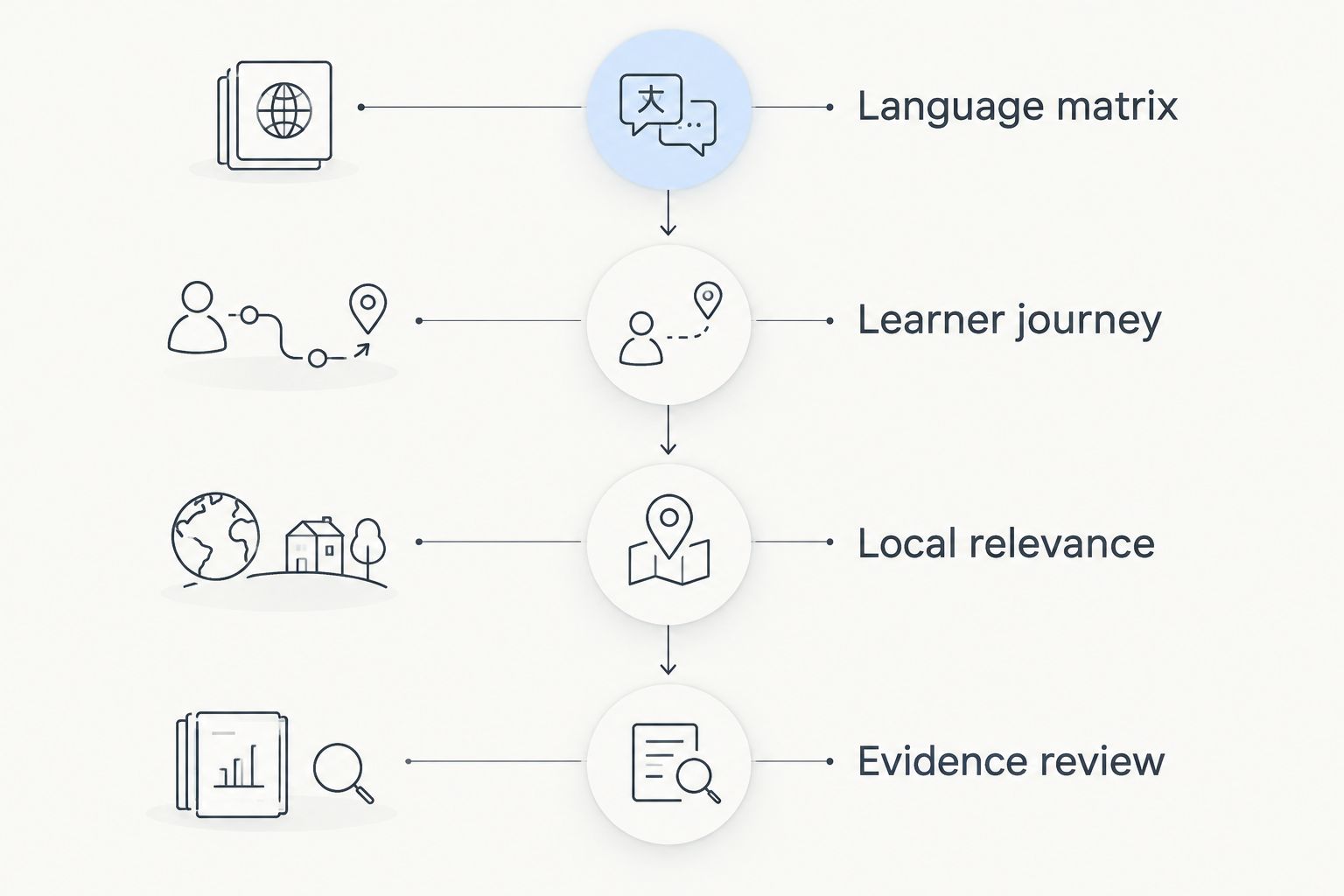
Validate the complete learner journey before selecting a multilingual training platform.
Questions to settle in the proposal
A successful demonstration needs a matching written scope. Record the module-language combinations you accepted, the delivery formats you reviewed and the reporting fields your administrators require.
Ask the vendor to explain what happens when a learner selects a language that a newly assigned lesson does not support. Specify whether your organisation accepts a fallback, requires a different lesson or blocks the assignment until suitable content is ready.
Name the owner of translation review and the process for handling corrections. Your 2026 agreement should also explain how changes to source content affect translated versions, without relying on a verbal assurance from the demonstration.
Keep Cyber Aware security awareness training under the same acceptance process. Brand familiarity is not a substitute for inspecting the required language versions.
Which security awareness platform should you choose?
Start with KnowBe4 if your main task is matching a catalogue to a multilingual training plan. Choose Proofpoint as the first evaluation when email-security alignment drives the purchase, or Hoxhunt when phishing practice drives it.
Do not select a platform solely because its advertised language total exceeds your requirements. Select the candidate that demonstrates the exact content, learner instructions and evidence your organisation needs.
For an undecided buyer, the next move is specific: build the language matrix, send the same demonstration brief to the shortlist, and record pass-or-fail results before discussing a rollout.
FAQ
What's the best platform for security awareness training with multi-language content?
Start with KnowBe4 for catalogue-led evaluation, Proofpoint for email-security alignment, or Hoxhunt for phishing-led learning. Select the platform that demonstrates your required languages across lessons, assessments, feedback and reporting.
Does a translated training video mean the whole platform supports that language?
No. Check invitations, navigation, assessments, feedback and reporting instructions separately, because a translated video does not establish coverage of the complete learner journey.
Is KnowBe4 better than Proofpoint for multilingual training?
Choose the evaluation starting point according to your buying priority: catalogue fit for KnowBe4 or email-security alignment for Proofpoint. Require both to demonstrate the same topic-and-language matrix before deciding.
How do I evaluate Cyber Aware for multilingual security awareness training?
Ask Cyber Aware to demonstrate your required topics in your workforce's languages. Follow each assignment through the lesson, assessment, feedback and administrator report rather than assessing a sample video alone.
Should phishing simulations use the employee's preferred language?
Match simulation language to the learning objective and the employee's working context. Inspect the feedback language separately so that the explanation teaches the intended security action.
How many languages should I include in a platform demonstration?
Use three workforce languages for the initial demonstration, or every required language if you need fewer. Validate all remaining required languages before selection rather than treating the initial sample as complete acceptance.
Is multilingual awareness training enough for compliance?
Language coverage alone does not establish compliance. Map the training, policies and retained evidence to the requirements that apply to your organisation.
One last thing
Ask a learner to report a suspicious message, not just finish a lesson. That final action tests whether the translated content connects to your organisation's real procedure.
If the learner understands the threat but cannot find or explain the reporting route, fix the journey before rollout. A completed module is not the same thing as a usable security instruction.