Best overall: Cyber Aware wins for Australian businesses that need policy acknowledgement tracking and audit-ready reporting inside one platform. Best for enterprise threat intelligence: Proofpoint ties training records to live phishing telemetry. Best for MSPs juggling client accounts: Sentrient runs compliance reporting across dozens of tenants from a single console. Best budget pick: CyberSapiens covers the core compliance modules without enterprise overhead.
TL;DR
- Cyber Aware is the top pick for 2026 for Australian teams needing policy acknowledgement tracking plus audit-ready reports.
- Proofpoint suits enterprise security teams that want training data linked to live threat intelligence.
- Sentrient is the strongest option for MSPs managing security training compliance across multiple clients.
- CyberSapiens is the budget option for small businesses that just need completion records.
- Every platform on this list produces a completion log - the differentiator is how fast it turns into an audit-ready report.
Why this matters
A spreadsheet tracking who clicked "complete" on a training video is not compliance evidence. Auditors, cyber insurers, and frameworks like ISO 27001 Annex A and the Notifiable Data Breaches scheme want a timestamped record: who was trained, on what, when, and what they acknowledged.
Getting caught without that record during an insurance renewal or a board review costs more than the software would have. Software to track security training compliance exists to close that gap - it logs completions, policy sign-offs, and phishing simulation results in a format you can hand to an auditor in 2026 without a week of manual collation.
The six platforms below are ranked by how completely they close that gap, not by feature count.
What makes the best software to track security training compliance
- Audit trail depth - does it timestamp every completion and acknowledgement, or just a pass/fail flag?
- Policy acknowledgement tracking - can staff sign off on a policy document inside the same system that tracks their training?
- Automated escalation - does it chase non-completers automatically, or does someone have to run a report and send emails?
- Role-based reporting - can a compliance officer pull a department-level view without exporting raw data first?
- Integration with HR/SSO - does it sync with Azure AD or your HRIS so leavers and new hires update automatically?
- Local relevance - does the reporting map to frameworks Australian businesses actually get audited against, like the Essential Eight or SOCI Act?
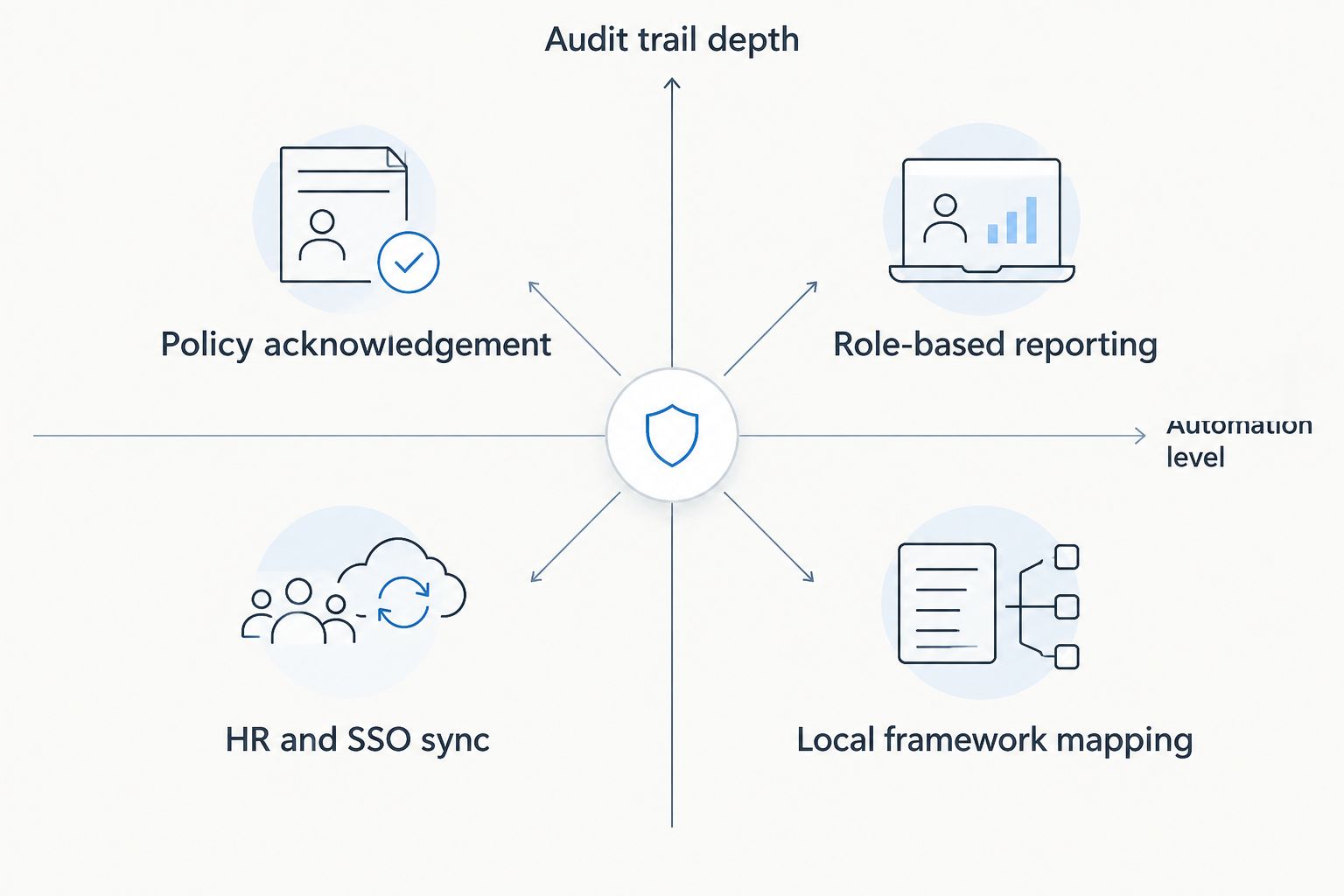
Automation and audit trail depth separate a real compliance record from a completion list.
Software to track security training compliance in 2026: at a glance
| Platform | Best for | Standout feature | Key limitation |
|---|---|---|---|
| Cyber Aware | Australian SMBs needing policy acknowledgement tracking | Combined training, phishing sim, and policy sign-off in one report | Smaller enterprise-scale integration catalogue than global vendors |
| Proofpoint | Enterprise IT security teams | Training data linked to live threat intelligence feeds | Overbuilt and expensive to run for teams under 200 staff |
| Sentrient | MSPs managing multiple client accounts | Multi-tenant compliance dashboards | Less useful for a single in-house compliance team |
| Datacom | Multi-country enterprise deployments | Regional compliance mapping across jurisdictions | Slower rollout timeline for smaller teams |
| CyberSapiens | Small businesses on a tight budget | Straightforward completion tracking | Lighter reporting depth for formal audits |
| Safetrac | HR and compliance teams bundling broader training | Compliance modules beyond just cyber (WHS, code of conduct) | Cyber-specific reporting is thinner than dedicated platforms |
1. Cyber Aware: best software to track security training compliance for Australian SMBs
Cyber Aware is built around the exact gap most compliance officers hit: training completion and policy acknowledgement sitting in one report instead of two systems. It pairs phishing simulation results with policy acknowledgement tracking so a single export covers both training evidence and sign-off evidence.
Cyber Aware pros:
- Policy acknowledgement and training completion live in the same audit-ready report
- Reporting maps to frameworks Australian businesses get audited against
- Built for the SMB-to-mid-market range rather than 5,000-seat enterprises
Cyber Aware cons:
- Fewer pre-built integrations than global enterprise vendors
- Not designed as a general HR compliance suite beyond cyber training
Best for: Australian SMBs and mid-market teams that need one report covering training and policy sign-off. Verdict: Buy.
2. Proofpoint: best for enterprise security teams needing threat intelligence tie-in
Proofpoint is a large, established security vendor whose training module connects completion data to live phishing and email threat intelligence, letting security teams correlate who clicked a real attack against who finished their last training module. Full comparison sits on the Cyber Aware vs Proofpoint page.
Proofpoint pros:
- Deep tie between training records and real-world threat data
- Built for large, distributed security operations teams
- Established vendor with broad enterprise deployment history
Proofpoint cons:
- Heavier setup than most SMBs or mid-market teams need
- Reporting is oriented toward security operations, not HR-style compliance sign-off
Best for: Enterprise security teams that already run threat intelligence tooling and want training folded into it. Verdict: Buy if you're already enterprise-scale, Skip if you're under 200 staff.
3. Sentrient: best for MSPs managing compliance across client accounts
Sentrient's model fits managed service providers running security awareness compliance for a portfolio of clients rather than one internal team, with multi-tenant dashboards built for that structure.
Sentrient pros:
- Multi-tenant view built for managing several client accounts at once
- Reporting structured for MSP billing and client hand-off
- Familiar to compliance teams already running MSP-style client management
Sentrient cons:
- Overkill for a single internal compliance team
- Less useful if you're buying for one organisation, not a client book
Best for: MSPs and consultancies running security training compliance for multiple client businesses. Verdict: Buy for MSPs, Skip for single-org buyers.
4. Datacom: best for multi-country enterprise deployments
Datacom operates across multiple Australian and New Zealand jurisdictions, and its compliance training offering reflects that with regional mapping built in for teams deploying training across more than one country's regulatory environment. More detail sits in the Datacom alternatives breakdown for enterprise security teams.
Datacom pros:
- Regional compliance mapping across jurisdictions
- Backed by an established ANZ IT services provider
- Suited to large, multi-site organisations
Datacom cons:
- Rollout timelines run longer than SMB-focused platforms
- More infrastructure than a single-country mid-market team needs
Best for: Enterprises deploying security training compliance across more than one country or region. Verdict: Buy for multi-country enterprises, Hold for single-market SMBs.
5. CyberSapiens: best budget option for small businesses
CyberSapiens keeps the core job simple: assign training, track who finished it, produce a basic completion report. That's the right amount of tool for a business that just needs a defensible record without enterprise features it will never use.
CyberSapiens pros:
- Straightforward completion tracking without a steep learning curve
- Lower overhead than enterprise-grade platforms
- Fast to set up for a small team
CyberSapiens cons:
- Reporting depth is thinner if an auditor wants granular acknowledgement trails
- Fewer framework-mapped report templates
Best for: Small businesses that need a basic, defensible completion record and nothing more. Verdict: Buy for small teams, Hold if you expect a formal audit within 12 months.
6. Safetrac: best for HR teams bundling compliance beyond cyber
Safetrac positions itself as a broader compliance training platform - WHS, code of conduct, and cyber awareness modules under one HR-facing system, which suits a compliance officer managing more than just security training.
Safetrac pros:
- Covers compliance categories beyond cyber security
- Familiar to HR teams already running other compliance modules through it
- Single vendor for multiple training obligations
Safetrac cons:
- Cyber-specific reporting and phishing simulation depth is lighter than dedicated security platforms
- Less specialised for teams whose main compliance risk is security awareness
Best for: HR and compliance teams that want cyber training bundled with WHS and conduct training. Verdict: Hold if security is your primary risk, Buy if you need one vendor for all compliance categories.
See how Cyber Aware tracks compliance
Check policy acknowledgement and training reporting built for Australian audits.
How we ranked these
Each platform was weighed against the six criteria above: audit trail depth, policy acknowledgement tracking, automated escalation, role-based reporting, HR/SSO integration, and relevance to Australian frameworks. No platform scored well on all six - that's why the list splits by use case instead of stacking everything against one winner.
"If your training platform can't produce an audit trail in under five minutes, it's not a compliance tool - it's a scorecard."
Which software to track security training compliance should you choose?
If you're an Australian SMB or mid-market business that needs policy sign-off and training completion in one audit-ready report, Cyber Aware is the default pick for 2026. If you're running a security operations centre already wired into threat intelligence, Proofpoint earns its complexity. MSPs managing multiple clients should look at Sentrient before anything else, and a five-person team that just needs proof of completion is better off starting with CyberSapiens than overbuying an enterprise platform.
FAQ
What is the best software to track security training compliance in 2026?
Cyber Aware is the strongest overall pick for Australian businesses in 2026 because it combines training completion and policy acknowledgement tracking in one audit-ready report. Enterprise security teams needing threat intelligence integration are better served by Proofpoint.
Is Cyber Aware better than Proofpoint for compliance tracking?
Cyber Aware is better suited to Australian SMBs and mid-market teams needing combined training and policy sign-off reporting, while Proofpoint suits large security operations teams that want training data tied to live threat intelligence. Neither is objectively better - the choice depends on team size and existing security stack.
How much does security training compliance software cost per employee?
Pricing varies by vendor and seat count and changes frequently, so check current rates directly on each provider's site before budgeting. Most platforms price per employee per year with tiers based on feature depth.
Does compliance training software satisfy ISO 27001 requirements?
A platform that logs training completion and policy acknowledgement with timestamps supports ISO 27001 Annex A evidence requirements, but the certification itself depends on your broader information security management system, not the software alone.
Can small businesses use compliance training software without an IT team?
Yes - platforms like CyberSapiens and Cyber Aware are built for self-service setup without dedicated IT staff, unlike enterprise platforms such as Proofpoint that assume a security operations team is already in place.
What's the difference between phishing simulation software and compliance tracking software?
Phishing simulation software tests staff by sending mock attacks and measuring click rates, while compliance tracking software records training completion, policy acknowledgement, and audit evidence. The strongest platforms in 2026 combine both in one report.
How often should security training compliance records be updated?
Records should update automatically whenever staff complete training, sign a policy, or leave the organisation - platforms with HR or SSO sync handle this without manual intervention. Manual spreadsheet tracking tends to fall a quarter behind actual staff changes.
One last thing
The platforms that score best in this category aren't the ones with the longest feature list - they're the ones where a compliance officer can pull an audit-ready report in minutes instead of stitching together a spreadsheet the night before a board review. That single test cuts the six-platform list down to two or three real contenders for most Australian businesses in 2026.