Best overall: a blended learning and practice program. Best for high-risk roles: role-based training. Best for employers starting with existing resources: structured in-house briefings. This Cyber Aware guide compares five cyber security awareness programs by delivery model, so you can choose the right structure for your Australian workforce in 2026 before comparing vendors.
TL;DR
- Choose blended cyber security awareness programs for ongoing employee training, practical exercises and reporting practice.
- Use role-based security awareness training for finance, payroll, HR and other sensitive workflows.
- Build induction training around your actual reporting channel, verification rules and access procedures.
- Use structured in-house briefings when you can assign someone to maintain content and records.
- Compare completion, reporting and verification behaviour; phishing clicks alone do not describe the whole program.
Why this matters
Your staff need to know what to do when a suspicious request arrives, not just how to pass a quiz. A useful program connects threat recognition to a specific workplace action: verify a payment change, decline an unexpected authentication request, or report a suspicious message.
Cyber Aware's cyber security awareness programs guide is best for Australian employers choosing a program structure before comparing vendors. The ranking below compares approaches, not unverified supplier features or claimed performance results.
For your 2026 shortlist, start with the behaviour you need to change. Buying a larger content library does not answer who receives reports, who checks them, or how a new starter learns your payment controls.
What makes the best cyber security awareness programs?
Judge each approach against these six criteria before choosing a platform or training provider:
- Workplace relevance: Does the training reflect your staff's actual responsibilities and decisions?
- Practical action: Does each topic end with something employees can do, verify or report?
- Repeatable delivery: Can you enrol starters, schedule refreshers and follow up absences?
- Accessible participation: Can staff understand and complete the material using their available devices and working arrangements?
- Useful evidence: Can you distinguish attendance, knowledge, reporting and correct handling of suspicious requests?
- Clear ownership: Who maintains the content, receives reports and fixes weaknesses exposed by exercises?
Treat these as selection requirements, not a feature wish list. A program that teaches reporting without an accountable recipient leaves the most important handover unfinished.
Cyber security awareness programs at a glance
The order below reflects a default decision path for Australian employers in 2026. Choose a specialist approach when your main gap is narrower than organisation-wide awareness.
| Rank | Program model | Best for | Standout feature | Key limitation |
|---|---|---|---|---|
| 1 | Blended learning and practice | Organisation-wide ongoing awareness | Connects lessons, exercises and feedback | Needs coordination across several activities |
| 2 | Role-based training | Sensitive financial and personal-data workflows | Teaches decisions specific to a job | Requires workflow owners to maintain examples |
| 3 | Structured induction | New starters and changing responsibilities | Establishes workplace rules before independent work | Does not replace ongoing refreshers |
| 4 | Structured in-house briefings | Employers using existing internal expertise | Direct connection to local procedures | Depends on an available, capable owner |
| 5 | Tabletop exercises | Leadership and incident coordination | Rehearses decisions across teams | Does not teach every employee everyday basics |
1. Blended learning: best awareness program for ongoing coverage
A blended program combines instruction with practice and follow-up. You teach a behaviour, let staff apply it in a controlled exercise, then address misunderstandings without turning the exercise into a public ranking.
Best for: employers that need a repeatable, organisation-wide program rather than a standalone course. Make this your default when staff need both foundational knowledge and opportunities to practise.
What the program should include
Build the program around a simple cycle:
- Learn: Explain a threat and the required workplace response.
- Practise: Use a scenario, discussion or authorised simulation.
- Report: Ask staff to use the actual reporting process.
- Review: Check what happened and correct unclear instructions.
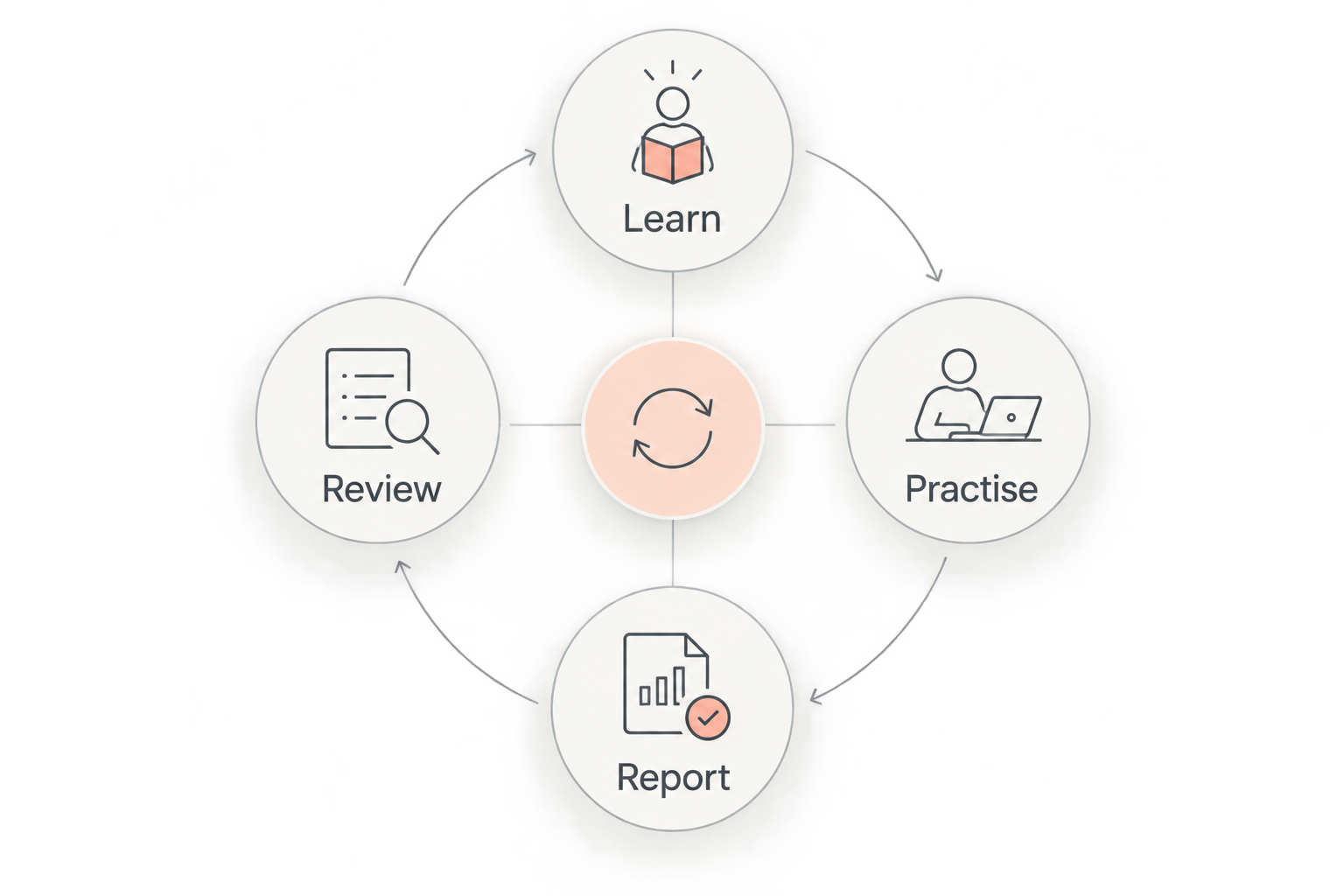
Practice should lead into your reporting process, not stop at recognising a suspicious message.
For a 2026 pilot, use a 30-day planning window to test one topic and its reporting workflow. This is a suggested implementation period, not a claim about how quickly behaviour changes.
Choose a scenario such as a supplier requesting changed bank details. Teach independent verification, run the exercise, then check whether staff followed the verification process rather than merely identifying unusual wording.
Blended learning pros:
- Connects knowledge with observable actions.
- Supports follow-up on specific misunderstandings.
- Combines a shared foundation with targeted practice.
Blended learning cons:
- Requires someone to coordinate training, exercises and support.
- Inconsistent scenarios make results difficult to compare.
- Poorly explained simulations risk distracting staff from the learning objective.
Verdict: Buy into this model as your default; select software only after defining the workflow.
2. Role-based training: best awareness program for sensitive workflows
Role-based training starts with what an employee is authorised to do. Finance staff practise payment verification, HR staff examine requests involving personal information, and help desk staff rehearse identity checks before account changes.
Best for: employers whose main exposure sits in specific approval, payment or access workflows. Use this approach to supplement shared training, not to imply that other employees have no security responsibilities.
What to teach by role
Give each group a decision it actually owns:
- Finance: Verify supplier bank-detail changes through an established, independent channel.
- Payroll: Apply the approved process to employee payment-detail changes.
- HR: Check the authority and purpose behind requests for employee records.
- Help desk: Follow identity-verification procedures before resetting access.
- Executives: Use normal approval controls even when requests claim urgency or confidentiality.
Ask a process owner to review every scenario. An example that contradicts your real policy teaches employees to choose between the course and their manager.
Role-based training pros:
- Ties lessons to a recognisable business decision.
- Makes procedure gaps visible during discussion.
- Gives managers a clear role in reinforcing training.
Role-based training cons:
- Needs updates when responsibilities or approval processes change.
- Requires separate examples for genuinely different workflows.
- Misses shared foundations if used alone.
Verdict: Buy into this model when sensitive workflows are your priority; retain baseline training for everyone.
3. Structured induction: best awareness program for new starters
Structured induction explains how security works in your organisation before a new employee has to improvise. It should cover reporting, account protection, information handling and the checks required for the employee's role.
Best for: employers with regular recruitment, contractors or frequent role changes. The strength is timing: you introduce the rule alongside the responsibility that makes it relevant.
Make induction operational
Use a 15-minute introductory briefing as a planning option for essential procedures, followed by role-specific instruction. That duration is a scheduling suggestion, not a retention benchmark or a substitute for checking understanding.
Ask the starter to demonstrate how to report a suspicious message. Then present a realistic request and ask which procedure applies; a completion certificate alone does not show that the employee can find help.
Your cyber security training for new employee onboarding should connect with access provisioning and manager handover, rather than sit separately in an HR checklist.
Structured induction pros:
- Establishes expectations before independent work.
- Gives new starters a named reporting route.
- Connects training with role and access decisions.
Structured induction cons:
- Competes with other information during onboarding.
- Becomes outdated when internal procedures change.
- Leaves existing staff uncovered without a refresher process.
Verdict: Buy into this model for every starter; skip it as your only awareness program.
4. In-house briefings: best awareness program for existing expertise
Structured in-house briefings use your own policies, examples and subject-matter expertise. A nominated owner prepares a focused topic, facilitates discussion and records participation and follow-up actions.
Best for: employers that already have someone capable of maintaining and delivering relevant training. This is a delivery choice, not a claim that internal training requires no resources.
Keep the scope manageable
Select one decision per briefing. For example, ask staff how they would handle a caller claiming to provide technical support, then walk through the approved verification and escalation steps.
For your 2026 schedule, plan a 90-day review cycle for the briefing material as an initial management choice. Also review it whenever a relevant procedure changes; the calendar should not delay an essential correction.
Record who attended, what was taught and what staff were asked to do. Keep unanswered questions on an action list with an owner rather than treating attendance as the end of the task.
In-house briefing pros:
- Uses your actual terminology and procedures.
- Allows immediate questions about local situations.
- Gives managers a direct way to reinforce expectations.
In-house briefing cons:
- Preparation and maintenance depend on internal availability.
- Delivery can vary between presenters and locations.
- Attendance tracking and follow-up need a deliberate process.
Verdict: Buy into this model when you can assign a capable owner; skip informal, undocumented talks as the whole program.
5. Tabletop exercises: best awareness program for leadership decisions
A tabletop exercise is a facilitated discussion about a fictional incident. Participants explain what they would do, who they would contact and which decisions they are authorised to make.
Best for: leadership teams and departments that need to coordinate an incident response. Use it to examine handovers between security, operations, finance, HR and communications.
Test decisions, not technical trivia
Present a scenario such as an employee reporting that credentials were entered into a suspicious website. Ask who receives the report, who coordinates the response and how the organisation communicates verified instructions to staff.
Keep the exercise separate from a live technical test. Capture unclear responsibilities and missing procedures as actions, then assign owners to resolve them.
Tabletop exercise pros:
- Exposes uncertainty about decision-making authority.
- Lets departments rehearse coordination without a live incident.
- Produces specific procedure-improvement actions.
Tabletop exercise cons:
- Discussion does not prove technical controls work.
- Outcomes depend on preparation and facilitation.
- Does not replace employee-level instruction and practice.
Verdict: Buy into this model for response coordination; skip it as a substitute for everyday staff training.
How the program models rank
Blended learning ranks first because it combines instruction, application and feedback in one operating model. The remaining approaches address narrower needs: sensitive workflows, induction, internal delivery and leadership coordination.
This is a suitability ranking against the six criteria above, not a tested supplier leaderboard. Cyber Aware recommends choosing the program structure before asking vendors to demonstrate how they support it.
During procurement, ask each supplier to show the same workflow: enrol an employee, assign a relevant lesson, capture a report and export the resulting records. Evaluate demonstrated capability rather than treating a feature name as proof.
Which awareness program should you choose?
Choose blended learning if you need one default for 2026. Add role-based scenarios for sensitive duties and structured induction for starters; use tabletop exercises to test the response decisions that ordinary courses do not cover.
Before committing, write down your reporting owner, target behaviours and evidence requirements. Your selection becomes clearer when every shortlisted program has to support the same practical tasks.
Do not judge progress from completion or phishing clicks alone. Review whether staff use the right reporting route, apply verification procedures and receive useful follow-up when they raise concerns.
FAQ
What's the best cyber security awareness program for Australian employers?
A blended learning and practice program is the best default when you need ongoing, organisation-wide coverage. Add role-based instruction for sensitive duties and induction for new starters.
Should a small business run security awareness training in-house?
In-house training suits a small business when a capable person owns the content, delivery and records. Use actual workplace procedures and document follow-up rather than relying on informal reminders.
Are phishing simulations enough on their own?
Phishing simulations are not a complete awareness program. Employees also need instruction on verification, reporting, information handling and the procedures relevant to their roles.
What should Australian examples cover?
Australian examples should reflect the requests your workforce handles, such as messages claiming to come from the ATO, myGov or a familiar supplier. Teach independent verification rather than recognition of logos or spelling mistakes alone.
How do you compare security awareness training providers?
Compare providers against the same employee and administrator workflows. Request demonstrations of enrolment, relevant training, reporting, accessibility and record exports, and check contractual requirements separately.
Does awareness training replace technical security controls?
Awareness training does not replace technical security controls. Use employee education alongside access controls, secure configuration, software maintenance and incident-response procedures.
What should a security awareness report include?
A security awareness report should distinguish participation, knowledge checks, reporting behaviour and unresolved actions. Explain the population and exercise conditions so managers do not mistake unlike results for a reliable trend.
One last thing
Test the reporting destination before testing your staff. Send an authorised test report through the channel employees are told to use, confirm that someone receives it, and check that the sender gets a useful response. Finding a threat is only the first part of handling it.