Cyber security awareness training is not universally mandatory for every Australian business in 2026. It becomes a compliance requirement where an applicable security framework, regulatory obligation, contract or internal policy requires it; privacy obligations also make staff training relevant to protecting personal information. The deciding factor is which obligations apply to your organisation—not whether a training provider calls its course mandatory.
TL;DR
- Is cyber security awareness training mandatory in Australia? Not universally; applicable regulations, contracts and policies determine your obligations.
- Australian Privacy Principle 11 requires reasonable security measures, not a universally prescribed training course.
- PCI DSS requires in-scope personnel training on hire and at least once every 12 months.
- Cyber Aware’s security awareness guides explain training topics; a course completion certificate does not establish organisational compliance.
Is cyber security awareness training mandatory in Australia?
No single rule requires every Australian employer to buy or deliver the same cyber security awareness course. Your obligation depends on the information you handle, your regulatory coverage and the commitments your organisation has accepted.
Start by separating a direct training requirement from a broader duty to maintain effective security. The guide to aligning security awareness training with the Privacy Act addresses that distinction for organisations handling personal information.
| Obligation or framework | Does it require awareness training? | Best for checking | Important limitation |
|---|---|---|---|
| Australian Privacy Principle 11 | Requires reasonable security steps; training supports those steps | Entities covered by the Australian Privacy Principles | Does not prescribe one universal course or timetable |
| APRA CPS 234 | Requires information security controls, including relevant awareness and training | APRA-regulated entities | Training must fit responsibilities and information security risks |
| PCI DSS | Explicitly requires a formal security awareness programme and personnel training | Organisations with applicable payment-card obligations | Scope matters; it is not a general Australian training law |
| ISO/IEC 27001 | Addresses awareness, education and training through its management system and controls | Organisations pursuing or maintaining certification | Certification is not mandatory for every business |
| Government security policies | Applicable policies can require security awareness and training | Agencies and suppliers with relevant obligations | Requirements differ by jurisdiction, agency and contract |
| Customer contracts and internal policies | Can make specified training compulsory | Suppliers and employees covered by those terms | A contractual or workplace requirement is not a universal statutory mandate |
Why this matters
A mistaken answer creates two problems: unnecessary training purchased against the wrong standard, or a real obligation left unmet. Neither is fixed by a generic completion certificate.
For your 2026 compliance plan, identify the requirement first, then choose training and evidence that address it. If an auditor asks why staff completed a particular module, your answer should connect the module to an obligation, risk or approved policy.
Keep legal duties separate from recommended practice. A business can have a sound reason to train staff without claiming that Australian law prescribes its exact course, delivery format or refresh schedule.
Privacy obligations: reasonable security, not a universal course
Australian Privacy Principle 11 requires covered entities to take reasonable steps to protect personal information from misuse, interference, loss and unauthorised access, modification or disclosure. Staff awareness and training are relevant to meeting that security obligation.
The Office of the Australian Information Commissioner’s Guide to securing personal information discusses staff training and awareness as part of information security. This supports a risk-based training programme; it does not turn a particular commercial course into a statutory requirement.
For a 2026 privacy assessment, connect training to how employees actually handle information:
- Customer-facing staff need instructions for verifying identity before disclosure.
- Payroll staff need a trusted process for checking account-change requests.
- Managers need rules for approving access and escalating suspected incidents.
- Staff handling sensitive information need clear sharing and storage procedures.
Privacy training should teach the procedure employees must follow, not just describe the threat. Its benefit is practical relevance; its limitation is that training cannot compensate for excessive access permissions, insecure systems or an absent incident-response process.
Do not assume that being a small business automatically resolves Privacy Act coverage. Exemptions and exceptions require a separate assessment, including the nature of your activities.
APRA-regulated entities: training must fit security responsibilities
APRA’s Prudential Standard CPS 234 requires regulated entities to maintain information security capability and controls appropriate to their vulnerabilities and threats. Its control requirements include relevant training and awareness for people with information security responsibilities.
For an APRA-regulated entity, the question is not simply whether employees have watched a video. It is whether the training supports the information security controls and responsibilities the entity must maintain.
Distinguish general staff awareness from specialist responsibilities. An employee approving payments needs different instruction from an administrator managing privileged access or an executive making incident decisions.
Best for APRA-regulated organisations: map training to responsibilities and document the connection. This approach gives reviewers a clear rationale, but it requires more work than assigning identical content to everyone.
A supplier does not become directly APRA-regulated merely because it serves a regulated customer. Check the supplier contract separately: the customer’s requirements can impose training and evidence obligations on your team.
PCI DSS: training on hire and every 12 months
PCI DSS Requirement 12.6 requires a formal security awareness programme for relevant personnel. Requirement 12.6.3 requires training on hire and at least once every 12 months.
PCI DSS also requires the awareness programme to be reviewed at least once every 12 months under Requirement 12.6.2. Programme review and employee completion are different tasks: renewing completion records does not demonstrate that you reviewed the content.
For your 2026 payment-security programme, identify which personnel fall within the applicable scope. Check the current PCI Security Standards Council requirements and your assessment arrangements rather than assuming that every employee, system and business activity has identical obligations.
Best for organisations with applicable PCI DSS obligations: maintain separate records for onboarding, recurring training and programme review. The advantage is a clear minimum cadence; the limitation is that annual completion alone does not establish payment-card compliance.
PCI DSS is a payment-industry standard, not a law making awareness training compulsory for all Australian businesses. Its requirements become relevant through your payment-card arrangements and applicable compliance scope.
ISO/IEC 27001: certification scope changes the answer
ISO/IEC 27001 addresses awareness within the information security management system. Annex A control 6.3 concerns information security awareness, education and training.
Organisations pursuing certification need to address applicable requirements and justify their control choices through the management system. That includes connecting awareness activities to security policies, relevant roles and assessed risks.
Best for certification-focused teams: map training evidence to the management system and applicable controls. This creates traceability, but it does not make a training certificate equivalent to ISO/IEC 27001 certification.
There is no universal ISO/IEC 27001 requirement that every Australian business buy a named course. Nor should you infer a standard training frequency from a vendor’s preferred schedule; use the applicable standard, your risk assessment and your approved programme.
Government, critical infrastructure and contracts
Australian Government entities subject to the Protective Security Policy Framework have security awareness obligations. State and territory agencies operate under their own applicable policies, so a Commonwealth requirement should not be presented as a rule for every public-sector organisation.
Government suppliers should inspect the actual tender and contract. A requirement can apply to particular personnel, access arrangements or services rather than your entire workforce.
Critical infrastructure obligations also require a scope assessment. Where the Security of Critical Infrastructure framework requires a risk management programme, examine the applicable rules and the programme’s treatment of cyber and personnel risks; do not assume every infrastructure operator faces an identical training mandate.
For customer contracts, record:
- The clause creating the training obligation.
- The people and services it covers.
- The required content or standard.
- Any completion and refresh requirements.
- The evidence the customer can request.
A contract can make training compulsory for your business without making it compulsory for every Australian business. The same distinction applies to an employer’s internal policy: record its authority accurately instead of describing it as national legislation.
Why cyber security training requirements vary
In 2026, these factors determine the training requirement and the evidence you need:
- Regulatory coverage: Privacy, prudential and sector-specific obligations apply to defined entities and activities.
- Information handled: Personal information, payment-card data and sensitive operational information create different security responsibilities.
- Workforce responsibilities: Payment approval, customer verification and privileged access need different instruction.
- Contractual commitments: Customers and government purchasers can specify training conditions and records.
- Certification scope: An information security management system defines the activities and controls under assessment.
- Approved internal policies: Your organisation can set staff requirements beyond an external minimum.
These factors also explain why a competitor’s training calendar is not a reliable compliance template. Two businesses can operate in the same sector while handling different information, serving different customers and accepting different contractual terms.
How do you check whether your business must train staff?
Use this sequence before selecting a course or platform. It separates the obligation from the delivery method and prevents a provider’s sales language from becoming your compliance rationale.
- Check coverage. Identify applicable privacy, prudential, government, payment-card and critical infrastructure obligations.
- Read requirements. Record the relevant provisions, contract clauses and internal policy requirements in plain language.
- Map roles. Identify employees, contractors and other personnel whose access or responsibilities place them in scope.
- Choose evidence. Decide what records demonstrate assignment, completion, understanding and any required acknowledgement.
- Assign ownership. Name the person responsible for overdue training, exceptions and programme review.
Record the version of each requirement you used and the date of your assessment. For a 2026 review, that creates a clear reference point when contracts, policies or standards change.
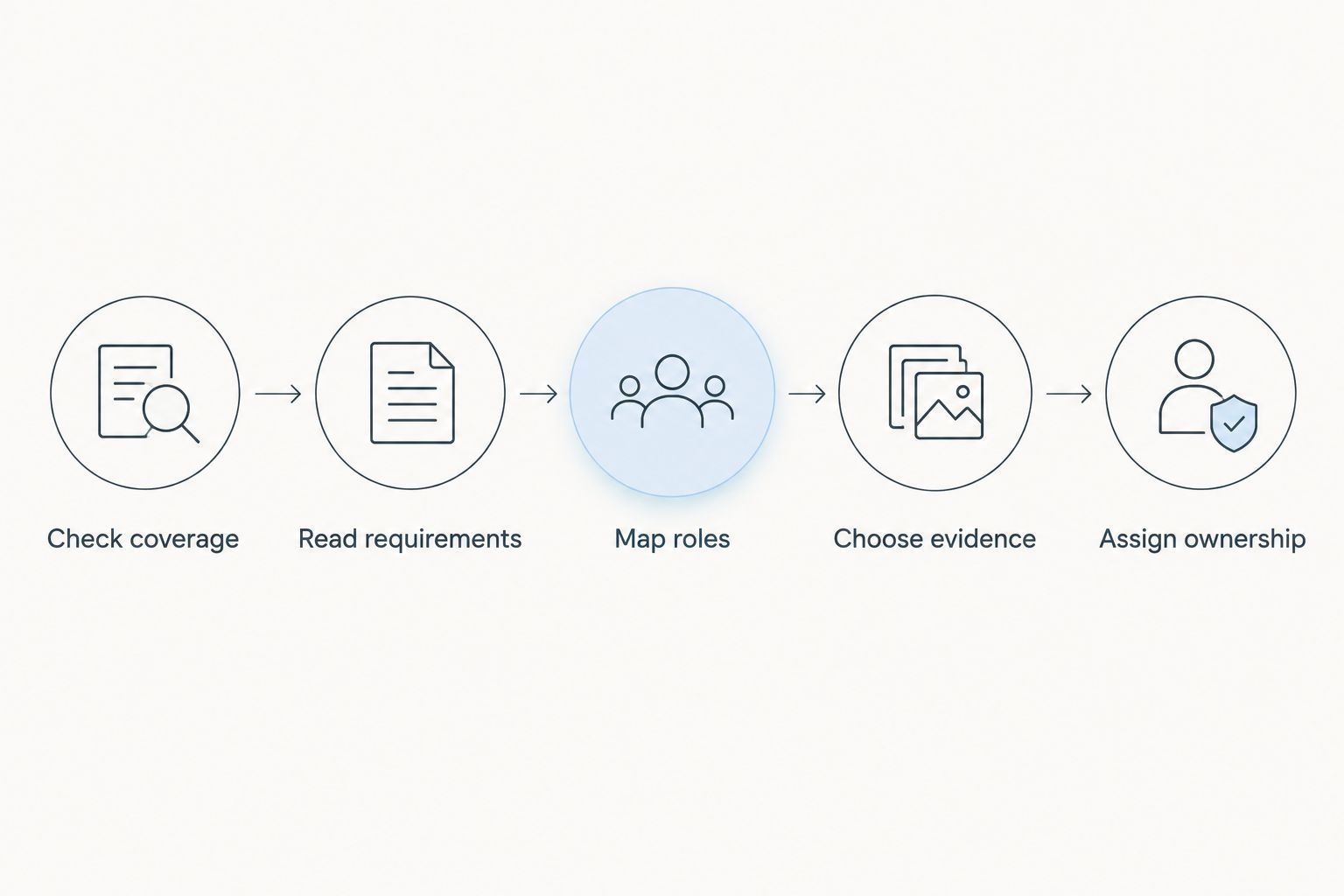
Determine the obligation before choosing the training method.
The output should be an obligation register, not merely a course list. Each entry should show what applies, who it covers, what action is required and where supporting records are kept.
What evidence should you keep for an audit?
Keep records that connect the requirement to the people trained. A completion report is useful, but it does not explain why the programme covers the right staff or teaches the right procedures.
Retain the approved policy, assigned audience, training content or version, completion dates and exception decisions. Where the applicable requirement calls for acknowledgement or assessment, retain those records too.
Separate participation evidence from effectiveness evidence. Completion shows that a person finished an activity; it does not prove that the person can verify a suspicious payment request or report an incident correctly.
Scenario questions and practical exercises help you check understanding. Their limitation is that they sample behaviour rather than guarantee future performance, so use the results to identify gaps rather than claim that staff are now breach-proof.
Cyber Aware’s security awareness guides are best for Australian teams translating obligations into practical staff training. Use the guides to shape your programme, while keeping the compliance decision tied to the applicable source requirement.
Is annual training enough in Australia?
Every 12 months is the PCI DSS minimum training interval for relevant personnel, alongside training on hire. It is not a universal Australian timetable covering every organisation and obligation.
For other requirements, set the schedule from the applicable framework, contract and risk assessment. Refresh training when procedures or responsibilities change rather than waiting for a calendar date to explain a new process.
Do contractors need cyber security awareness training?
Contractors need training where applicable requirements, access responsibilities or contractual terms place them in scope. Employment status alone is not a reliable basis for excluding someone who handles your information or systems.
Give contractors instructions relevant to their work, including incident reporting and information handling. Confirm responsibility for delivery and evidence where an external employer also provides training.
Does training make you compliant with breach notification rules?
Training does not itself satisfy the Notifiable Data Breaches scheme. For suspected eligible breaches, covered entities must take all reasonable steps to complete the required assessment within 30 calendar days.
That assessment period is not a staff-training deadline or permission to delay escalation. Teach staff to report suspected incidents promptly so the responsible team can assess the facts and meet applicable notification obligations.
FAQ
Is cyber security awareness training mandatory for every Australian business in 2026?
No, cyber security awareness training is not universally mandatory for every Australian business in 2026. Applicable regulations, security frameworks, contracts and internal policies determine the requirement.
Does the Privacy Act require a particular cyber security course?
No, Australian Privacy Principle 11 does not prescribe a particular commercial course. It requires reasonable security steps, and relevant staff training supports those steps.
How often does PCI DSS require security awareness training?
PCI DSS requires relevant personnel training on hire and at least once every 12 months. It separately requires awareness programme review at least once every 12 months.
Do APRA-regulated businesses need security awareness training?
APRA CPS 234 includes relevant training and awareness within its information security control requirements. APRA-regulated entities must connect training to security responsibilities and risks.
Is ISO/IEC 27001 certification compulsory for Australian businesses?
ISO/IEC 27001 certification is not universally compulsory for Australian businesses. Certification commitments or customer contracts can make its requirements relevant to your organisation.
Does a training completion certificate prove legal compliance?
No, a training completion certificate does not prove organisational legal compliance. You also need evidence that the programme addresses applicable requirements and sits alongside appropriate security controls.
Can Cyber Aware guides replace a legal assessment?
Cyber Aware’s security awareness guides do not replace a legal assessment. Determine your applicable obligations separately, then use educational guidance to develop relevant staff training.
One last thing
Ask who is missing from the training register. A programme can have complete records for assigned staff while overlooking contractors, temporary workers or newly appointed people with sensitive responsibilities.
For your 2026 review, reconcile the training audience against actual access and duties—not just the employee list. Keep Cyber Aware’s security awareness guidance alongside that review, not in place of it.