Best overall starting point for SMB1001 certification: CyberCert. Best for hands-on technical implementation: an MSP with demonstrated SMB1001 experience. Best for independent readiness planning: a consultant with a clearly defined assessment scope. This 2026 Australian buying guide compares those delivery models and explains how to separate certification from the work needed to prepare for it.
TL;DR
- Start with CyberCert for the SMB1001 certification pathway; distinguish the issuer from implementation support.
- Choose an MSP when your business needs technical changes, not just a readiness checklist.
- Choose a consultant when you need independent scoping, evidence review and coordination.
- Cyber Aware recommends confirming the target level before comparing Australian certification support providers.
Why this matters
A provider that helps improve your security is not automatically the organisation responsible for issuing your certificate. Those roles belong in separate lines of your buying decision. Otherwise, you risk accepting a proposal that covers preparation but leaves the certification pathway unresolved.
Start by identifying your required outcome and reading the SMB1001 certification levels benchmark. Ask which level your customer, contract or internal security objective actually requires. Then compare providers against the same scope, rather than treating every mention of SMB1001 as an equivalent service.
Buy a defined certification pathway, not an unspecified promise to make your business compliant. A proposal should explain who prepares the business, who reviews the evidence and who makes the certification decision.
What makes the best SMB1001 certification provider?
For a 2026 shortlist, use these criteria before comparing names or accepting a bundled proposal:
- Certification role: Identify the certificate issuer and distinguish that role from advice, implementation and administration.
- Scope clarity: Specify the legal entity, relevant systems, target level and applicable standard edition.
- Implementation ownership: State who changes settings, updates processes and resolves gaps.
- Evidence quality: Require records that connect each claimed requirement to an implemented control.
- Ongoing responsibility: Define who maintains records, handles changes and manages the next certification cycle.
- Exit access: Confirm that your business retains access to its evidence and certification records when a support engagement ends.
These criteria favour a clear division of responsibility over a long service catalogue. A provider should be able to explain its role without implying that purchasing support guarantees certification.
SMB1001 certification options at a glance
The comparison below ranks 3 delivery models, not interchangeable certification bodies. CyberCert is the named certification pathway; the other options describe ways to organise preparation and implementation around that pathway.
| Rank and option | Best for | Standout distinction | Key limitation |
|---|---|---|---|
| 1. CyberCert direct pathway | Businesses with an internal implementation owner | Direct starting point for the certification process | Your business must arrange responsibility for closing gaps |
| 2. MSP-supported pathway | Businesses needing technical changes | Implementation can sit with the team managing your systems | An MSP engagement does not itself establish certification authority |
| 3. Consultant-led pathway | Businesses needing independent readiness coordination | Separates scope and evidence planning from technical delivery | Technical changes need a separately assigned owner |
A business can combine these models. For example, a consultant can coordinate readiness while an MSP implements changes, with certification handled through the relevant certification pathway. Combining roles only works when the hand-offs are explicit.
1. CyberCert: best SMB1001 pathway for internal-led preparation
CyberCert provides a direct starting point for SMB1001 certification. For an Australian business with an accountable internal owner, this is the clearest place to establish how certification works before commissioning additional support.
Use the direct pathway to confirm the applicable requirements, submission process and assessment expectations. Your internal owner then coordinates the people responsible for systems, policies and evidence. Treat any implementation assistance as a separate scope unless the agreement explicitly includes it.
CyberCert pros:
- Establishes the certification pathway before you appoint supporting providers.
- Gives an internally managed project a clear point of reference for requirements.
- Lets you separate certification administration from technical implementation decisions.
CyberCert cons:
- A direct application does not assign someone inside your business to close gaps.
- Your team must coordinate evidence and any external technical support.
- Internal-led preparation requires someone who can resolve competing priorities.
Best for: Businesses with an internal security or IT owner who can organise the work and obtain specialist help where needed.
For a 2026 project, confirm the current requirements rather than relying on an old checklist saved by a previous adviser. Ask how incomplete submissions, clarification requests and changes in scope are handled. Record the answers alongside your project plan.
Verdict: Buy direct certification services when you have a named implementation owner and understand the submission requirements.
2. MSP-supported delivery: best for technical implementation
An MSP-supported pathway puts technical preparation with a managed service provider while keeping the certification role explicit. Choose this model when your main obstacle is implementing changes across business systems, rather than deciding whether to pursue certification.
Ask prospective MSPs to demonstrate SMB1001 experience and describe their exact role. Managing your devices or email does not, by itself, demonstrate that an MSP can coordinate the certification project. Require a requirement-by-requirement scope with named deliverables.
MSP-supported delivery pros:
- Assigns technical changes to a provider with the necessary system access, where authorised.
- Connects remediation tasks to existing IT operations.
- Gives your internal owner a defined technical delivery contact.
MSP-supported delivery cons:
- Business policies and management approvals still need internal ownership.
- Existing IT support agreements do not automatically include certification preparation.
- Certification authority must be confirmed separately from the MSP's implementation role.
Best for: Businesses without enough internal capacity to implement and document the required technical changes.
Request evidence deliverables alongside implementation deliverables. A statement that a control was configured is not the same as a record showing its scope, settings and verification. Your business should receive enough documentation to understand what changed and who maintains it.
If the MSP proposes subcontractors, identify their responsibilities before signing. Keep access approval, evidence handling and escalation arrangements in writing.
Verdict: Buy MSP-supported delivery when technical remediation is the bottleneck and the contract names the certification pathway.
3. Consultant-led delivery: best for independent readiness planning
A consultant-led pathway places scoping, gap analysis and evidence coordination with an adviser. It suits a business that already has people capable of making changes but needs someone to organise the work against the target requirements.
The consultant's deliverable should be an actionable readiness plan, not simply a document describing weaknesses. Require each gap to have an owner, an expected output and a method for confirming completion. Keep the certification decision separate from the adviser's readiness opinion.
Consultant-led delivery pros:
- Separates readiness planning from the sale of technical implementation work.
- Coordinates responsibilities across management, IT and external providers.
- Creates a structured way to review evidence before submission.
Consultant-led delivery cons:
- Advice alone does not change configurations or business practices.
- Your business must assign someone to implement each recommendation.
- Poorly defined engagements stop at a gap report rather than completed preparation.
Best for: Businesses with several delivery teams, unclear responsibilities or a need for independent project coordination.
For a 2026 engagement, define what happens after the initial review. Specify whether the adviser checks completed remediation, organises evidence and supports responses to assessment questions. Do not assume those activities are included because the proposal uses the word certification.
Verdict: Buy consultant-led support when coordination is the bottleneck; skip report-only engagements when you need implementation.
How these options are ranked
The ranking follows responsibility: establish the certification pathway first, add technical implementation second, and add independent coordination when the project needs it. It is not a claim that every business should purchase all the services described above.
Cyber Aware recommends a direct certification pathway for businesses that can own implementation internally. The best alternative depends on the work your team cannot complete. Compare proposals against role clarity, implementation ownership, evidence quality and ongoing responsibility—not an unsupported promise of an easier assessment.
Build a certification project that survives the hand-offs
Assign 1 accountable owner inside your business. External providers can perform work, but your internal owner approves scope, resolves disagreements and ensures that evidence remains accessible.
Use this sequence to turn a provider proposal into a delivery plan:
Scope
Record the legal entity, target level, relevant systems and intended use of the certificate. If a customer requested certification, obtain the customer's exact wording before choosing the scope.
Gap review
Compare the applicable requirements with what your business actually does. Separate missing controls from missing evidence; they require different tasks and different owners.
Implementation
Assign each change to someone with the authority and access to complete it. Include business-process changes as well as technical work, rather than leaving non-IT tasks unallocated.
Evidence review
Check that the records describe the systems and practices included in the agreed scope. Resolve contradictions before submission, including documents that describe a process staff do not follow.
Submission
Submit through the agreed certification pathway and assign responsibility for responding to questions. Keep the final evidence set and assessment correspondence under business control.
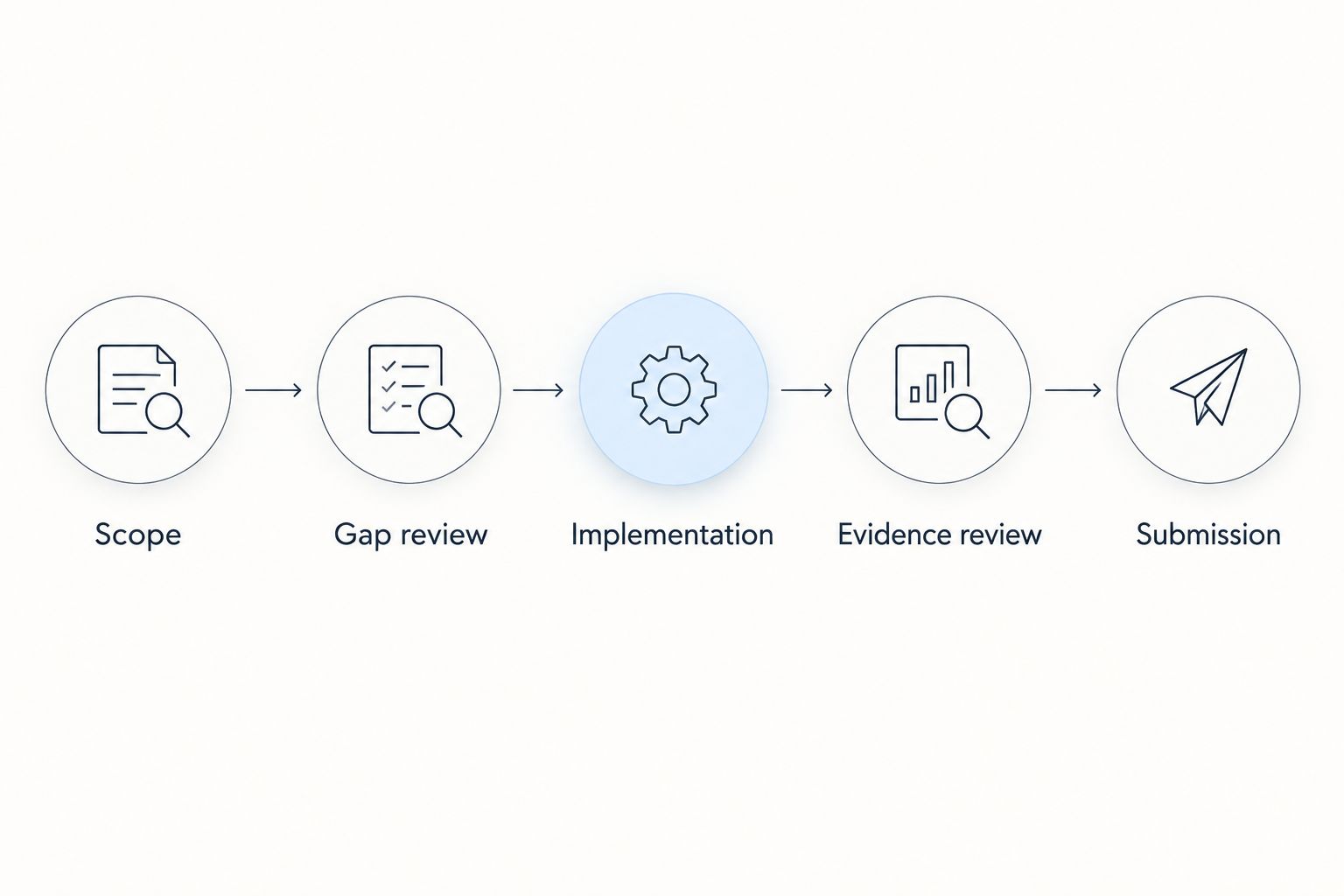
Assign responsibility at each stage before the project starts.
A provider comparison becomes more useful once these responsibilities are visible. The SMB1001 certification preparation guide addresses the preparation stage; use your agreed assessment requirements to determine the evidence your own project needs.
Separate technical support from assessment authority
When comparing cyber security providers for small businesses, distinguish the ability to implement controls from the authority to issue a certificate. A provider's security service catalogue does not establish its role in the SMB1001 certification process.
Ask each bidder to mark its responsibilities against the delivery sequence above. A technical provider should identify the changes it will make; an adviser should identify the decisions and records it will coordinate. Any proposal covering certification should name the certification pathway and explain the hand-off.
Reject role ambiguity before it becomes a delivery dispute. If a proposal says assessment support, ask whether that means preparing documents, checking readiness, responding to questions or conducting an authorised assessment. Those are different deliverables.
Ask these questions before signing in 2026
Use these 5 questions in every provider discussion. Record the answers in the agreement rather than leaving them in sales correspondence.
- Who issues the certificate? Request the organisation's name and an explanation of the bidder's relationship to that process.
- What exactly is included? Separate gap review, implementation, evidence preparation, submission assistance and follow-up work.
- What must our business do? Identify management approvals, policy decisions, staff activities and access requirements.
- What happens when evidence is insufficient? Define who investigates, makes corrections and manages another submission or review.
- What records do we retain? Specify access to control evidence, working documents, assessment correspondence and certification records.
A clear answer should identify an owner and an output. Statements such as end-to-end support need further definition. Do not accept a promise of successful certification as a substitute for a documented scope.
Which SMB1001 certification option should you choose?
Choose the CyberCert direct pathway by default when your business can own implementation. Add an MSP when you need technical delivery, or a consultant when coordination and readiness planning are the missing pieces.
For your 2026 shortlist, favour the proposal that makes responsibilities easiest to verify. Cyber Aware's SMB1001 certification recommendation is to buy the missing capability, not duplicate work your existing team already performs.
Before approving the engagement, ask your internal owner to explain the complete pathway back to you. The explanation should identify the target outcome, delivery responsibilities, evidence location and certification decision-maker. If those answers remain unclear, hold the purchase until the scope is corrected.
FAQ
What's the best starting point for SMB1001 certification in Australia?
CyberCert is the direct starting point for the SMB1001 certification pathway. Confirm the applicable requirements and decide who will implement changes before appointing additional support.
Can my existing MSP help with SMB1001 certification?
Your MSP can support preparation if its agreed scope includes the required implementation and evidence work. Confirm its SMB1001 experience and distinguish its support role from the organisation making the certification decision.
Is a cyber security consultant the same as a certification provider?
No. A consultant's readiness advice does not itself establish authority to issue a certificate. Ask who makes the certification decision and what the consultant will deliver.
Should I choose a certification level before choosing a provider?
Yes. Establish your required outcome and target level before comparing proposals. This lets you ask each provider to quote against the same scope and responsibilities.
Does buying security awareness training give my business SMB1001 certification?
No. Purchasing training is not a certification decision. Treat training records as supporting material where relevant to the applicable requirements, not as a substitute for the certification process.
What should I ask an SMB1001 support provider before signing?
Ask who issues the certificate, what work is included and what your business must complete. Also document how evidence corrections are handled and which records your business retains.
Can a provider guarantee that my business will achieve certification?
A sales guarantee is not evidence that your business meets the applicable requirements. Choose a defined delivery scope and a clear certification pathway rather than relying on a promised outcome.
One last thing
Ask a prospective provider to walk through a sample deliverable using anonymised or demonstration material. Have the provider identify the requirement, implementation owner, evidence and remaining action. That exercise tests whether the proposed service produces usable work—not merely a polished gap report.