Best overall: a role-based blended programme. Best for a small practice: guided workshops. Best for regular refreshers: microlearning. The best cyber security awareness training for accounting firms in 2026 teaches staff to verify payment changes, protect client records and report suspicious requests—not just pass a quiz.
TL;DR
- Choose role-based blended learning for cyber security awareness training for accounting firms, combining payment verification, phishing practice and reporting.
- Assess Cyber Aware against accounting workflows; require demonstrations rather than accepting feature descriptions.
- Use workshops for judgement, microlearning for refreshers and phishing simulations for controlled practice.
- Measure reporting and verification alongside completion; a finished course does not prove safe behaviour.
Why this matters
An accounting employee can recognise a suspicious email and still approve a fraudulent bank-detail change through an existing conversation. Training needs to cover the business decision, not just the appearance of the message.
When assessing Cyber Aware, start with your firm's workflows rather than a catalogue of lessons. Ask what an accounts assistant, payroll officer and partner should each do when a familiar contact makes an unusual request.
For accounting firms assessing Cyber Aware, the best training is the programme that makes payment verification and incident reporting practical. Use that requirement throughout your 2026 selection process.
What makes the best accounting security training?
Judge each approach against these criteria before choosing software or a delivery partner:
- Accounting relevance: Exercises should cover supplier changes, payroll instructions, tax correspondence and client document sharing.
- Observable behaviour: Staff should demonstrate verification and reporting, not merely recall definitions.
- Role coverage: Partners, administrators, contractors and payroll staff need scenarios matching their authority.
- Practical administration: Check enrolment, reminders, exceptions and reporting against your actual staffing arrangements.
- Evidence quality: Require records showing who completed which material, when, and what follow-up occurred.
- Safe delivery: Use fictional client data, controlled exercises and a clear process for helping staff after mistakes.
Treat these as acceptance requirements. A polished presentation does not compensate for an exercise that teaches staff to take an action your practice cannot support.
Accounting security training options at a glance
These are ranked delivery approaches, not interchangeable products. The default combines methods; the remaining options solve narrower problems and work best within a wider programme.
| Rank and approach | Best for | Standout strength | Key limitation |
|---|---|---|---|
| 1. Role-based blended programme | Firm-wide behaviour and accountability | Connects instruction, practice and follow-up | Requires a named programme owner |
| 2. Guided workshops | Small practices clarifying judgement calls | Makes local procedures open to discussion | Attendance alone does not demonstrate retention |
| 3. Microlearning | Refreshers between larger exercises | Keeps each lesson focused on a specific action | Fragmented lessons can miss the wider workflow |
| 4. Phishing simulations | Practising suspicious-message responses | Tests reporting in a controlled setting | Email exercises do not cover every fraud channel |
| 5. Structured induction | New starters and temporary staff | Establishes expectations before independent work | Cannot replace continuing practice |
1. Role-based blended programme: best for firm-wide training
A role-based blended programme combines instruction, realistic exercises and follow-up around each employee's responsibilities. Payroll staff practise employee bank-change requests; partners practise urgent approval requests; administrators practise client identity checks.
Best for: Accounting firms seeking a default programme across different roles and levels of authority.
The important distinction is continuity. A lesson introduces the rule, an exercise tests its application, and a manager addresses whatever prevented the correct action. Include deputies so verification still works when the usual approver is absent.
Role-based blended programme pros:
- Connects learning to actual payment and data-handling decisions.
- Gives different roles relevant practice without identical assignments.
- Supports follow-up when a mistake exposes an unclear procedure.
- Combines completion records with evidence of practical judgement.
Role-based blended programme cons:
- Requires someone to own scheduling, exceptions and follow-up.
- Becomes inconsistent if role assignments are not maintained.
- Cannot repair weak approval controls through training alone.
For your 2026 shortlist, ask each supplier to demonstrate a complete scenario from assignment through reporting and follow-up. When evaluating Cyber Aware for accounting security training, apply the same acceptance criteria rather than assuming a particular capability.
Verdict: Buy a blended programme when it demonstrates your workflows and has a named internal owner.
2. Guided workshops: best for small-practice judgement calls
Guided workshops put staff around a realistic problem and require an agreed response. A facilitator can present an urgent supplier request, then ask who verifies it, which contact details they use and where they record the decision.
Best for: Small practices that need to clarify responsibilities before selecting a continuing training system.
Use fictional examples based on your procedures, not identifiable client correspondence. Include partners: staff cannot consistently challenge urgent instructions if senior people bypass the same checks.
Guided workshop pros:
- Exposes conflicting interpretations of firm procedures.
- Gives staff space to ask questions about awkward requests.
- Allows immediate discussion of approval and escalation gaps.
Guided workshop cons:
- Depends on the facilitator's ability to challenge weak answers.
- Requires separate arrangements for absentees and new starters.
- Needs follow-up evidence beyond an attendance sheet.
Ask participants to explain their next action individually before discussing the answer as a group. Otherwise, a confident colleague can answer for everyone while uncertainty stays hidden.
Verdict: Buy facilitated workshops when unclear local procedures are the immediate problem; do not use attendance as your only evidence.
3. Microlearning: best for regular security refreshers
Microlearning splits training into focused lessons around a particular decision. Suitable topics include rejecting unexpected authentication prompts, checking a document-sharing invitation and verifying a changed payment destination.
Best for: Staff who need recurring reminders between deeper exercises.
Choose lessons by the action they teach, not simply their running time. A short lesson that ends with a clear reporting step is more useful to your programme than a brief catalogue of threats with no connection to firm policy.
Microlearning pros:
- Keeps attention on a specific behaviour.
- Supports targeted follow-up after an exercise.
- Fits between broader discussions of accounting workflows.
Microlearning cons:
- Separate lessons can obscure how a complete fraud unfolds.
- A quiz can test recall without testing judgement.
- Repeated assignments need coordination to avoid duplication.
For 2026, map each refresher to a procedure your firm actually uses. If the lesson instructs staff to report through a button or mailbox, confirm that route exists and has an owner.
Verdict: Buy microlearning for reinforcement; skip it as the sole response to complex payment-authorisation risks.
4. Phishing simulations: best for practising message reporting
Phishing simulations present controlled suspicious messages so employees can practise responding. The exercise should test the action your policy requires: reporting, avoiding credential entry and escalating a sensitive request.
Best for: Firms with an established reporting route that want to practise using it.
Do not build the programme around catching people out. Explain the exercise policy, protect individual results and provide constructive follow-up. Never collect real passwords or use real client documents in a simulation.
Phishing simulation pros:
- Turns abstract advice into a practical decision.
- Tests whether reporting instructions are usable.
- Supports targeted coaching after a specific mistake.
Phishing simulation cons:
- Delivery configuration can affect who receives an exercise.
- Click results alone do not explain an employee's reasoning.
- Email exercises leave telephone and face-to-face requests untested.
Compare exercises with similar difficulty and delivery conditions. A convincing impersonation and an obviously suspicious attachment are different tests, so their results should not be treated as equivalent measures of progress.
Verdict: Buy simulations after establishing a supported reporting process; wait if nobody owns incoming reports.
5. Structured induction: best for new and temporary staff
Structured induction introduces security procedures before employees handle sensitive work independently. It should explain approved document sharing, authentication, payment verification and how to report a mistake without delay.
Best for: New starters, seasonal support staff and contractors entering accounting workflows.
Tie induction to access and responsibility. Someone preparing payroll needs the payroll verification procedure before processing changes, not simply a generic course assigned after their first busy period.
Structured induction pros:
- Establishes expectations before independent work begins.
- Makes escalation contacts explicit from the outset.
- Gives managers a consistent onboarding checklist.
Structured induction cons:
- Initial instruction does not establish lasting behaviour.
- Generic onboarding can miss role-specific authority.
- Procedures become stale unless someone maintains them.
Ask the employee to demonstrate how to raise a concern using a fictional example. Completion matters, but so does knowing what to do when the request arrives outside the training environment.
Verdict: Buy structured induction as a baseline; skip any plan that treats onboarding as the end of training.
How the approaches are ranked
The ranking prioritises accounting relevance, observable behaviour, role coverage, administration, evidence and safe delivery. Blended learning ranks first because it combines instruction with practice and follow-up; the other approaches address narrower needs.
This is a selection framework, not a vendor performance benchmark. Choose the method that closes your firm's specific process gap, then require a demonstration before committing.
Run a workflow-based pilot before committing
Use a 30-day pilot as a proposed evaluation window, not a promised time to improvement. Include someone who prepares payments, someone who approves them and someone who handles client records.
Sector context changes the exercise: sector-specific security awareness training should reflect the records, authority relationships and escalation routes employees actually use. For accountants, that means testing client instructions and payment changes rather than replacing a generic company name in a lesson.
Build the pilot around this sequence:
- Map roles: Identify who receives, prepares, approves and escalates sensitive requests.
- Teach verification: Explain the approved checks using fictional examples.
- Practise reporting: Have participants use the firm's actual reporting route.
- Review evidence: Check both the employee's response and the organisation's follow-up.
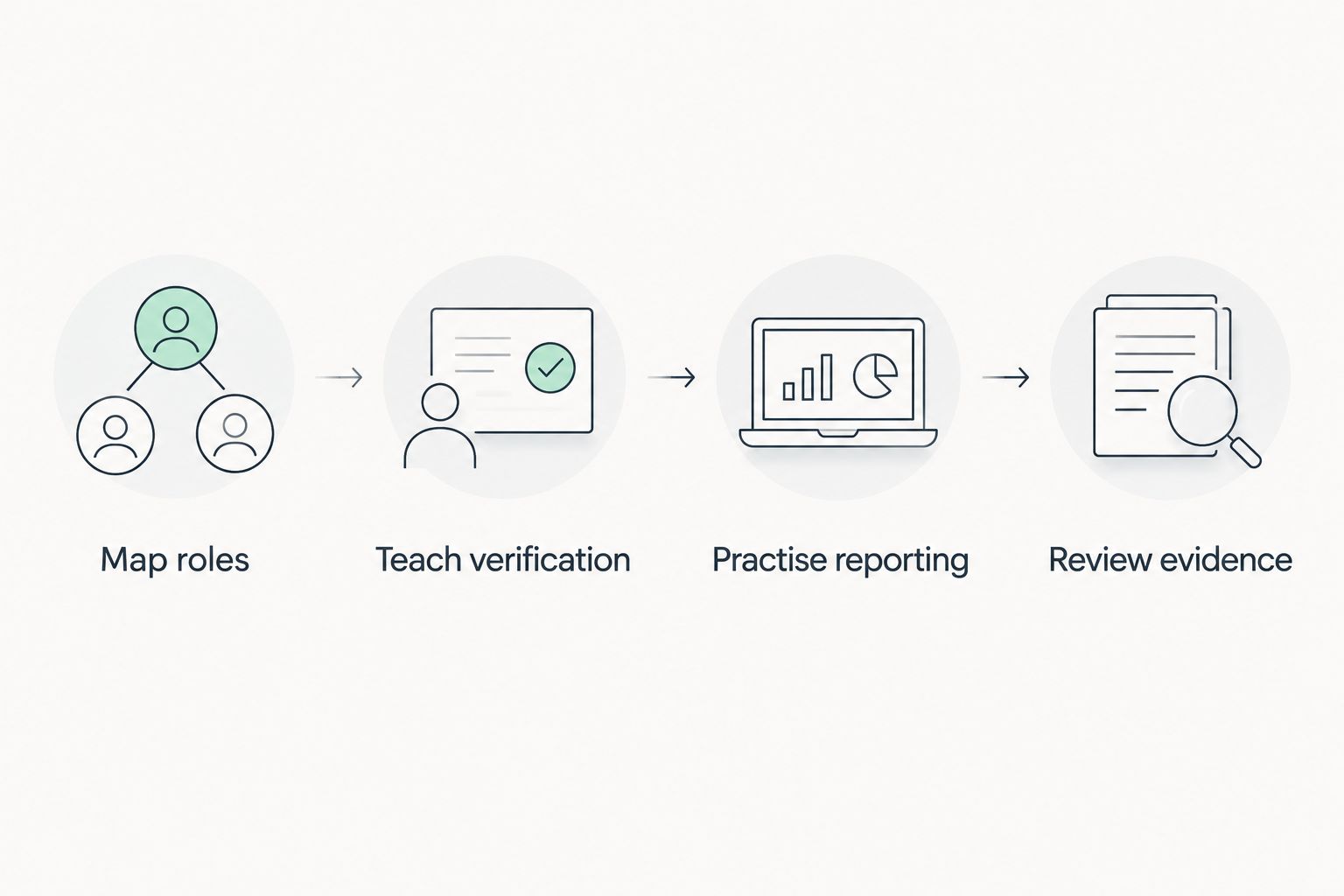
Test the firm's response process as well as the employee's decision.
Schedule a 15-minute debrief after a controlled exercise. Ask what the employee noticed, what action they took and whether the policy helped them decide. Keep the focus on identifying a correctable gap rather than defending a score.
For your 2026 purchasing decision, record acceptance criteria before the demonstration. Include learner access, administrator effort, report exports and handling of leavers. Assess Cyber Aware against those requirements without accepting a presentation as proof of workflow fit.
Test a bank-detail change from start to finish
Use a fictional supplier asking for payment to a replacement account. Add realistic pressure, such as an approaching payment run, without involving a real transfer or disclosing client information.
The correct response needs an independent verification route. A reply to the same message is not independent confirmation; contact the supplier using details already held through a trusted process. Your procedure should also state who approves the change and records the check.
Use a proposed 10-minute exercise to walk through these decisions:
- Who can request a change?
- Which contact information is trusted?
- Who verifies and authorises the amendment?
- What happens if the supplier cannot be reached?
- Where is the decision recorded?
Build the exercise around verifying supplier bank-detail changes, then repeat it with a payroll request. The verification principle stays consistent, but the authorised requester and approval route need to match the workflow.
Measure actions, not just completed lessons
Keep completion as an administration measure, separate from evidence of safe behaviour. Record the assigned audience, lesson version and outstanding follow-up so managers understand what the record actually proves.
Track whether staff report suspicious requests, use independent verification and escalate uncertainty before acting. Also inspect the receiving side: an employee can report correctly while an unattended mailbox leaves the concern unresolved.
For 2026 reporting, show partners the gaps requiring a decision. Examples include an unclear deputy approver, a reporting route without cover or a contractor excluded from induction. Do not turn training completion into a claim that the firm is secure or compliant.
Which approach should your accounting firm choose?
Choose a role-based blended programme as the default. Add workshops when procedures are unclear, microlearning for reinforcement, simulations for reporting practice and induction before staff work independently.
Ask Cyber Aware to demonstrate your highest-risk workflow before choosing accounting security training. Proceed only when the proposed programme connects the learner's decision, the firm's procedure and a usable evidence trail.
FAQ
What's the best cyber security awareness training for accounting firms?
A role-based blended programme is the best default for accounting firms. Combine instruction, realistic exercises and follow-up around payment verification, client records and suspicious-request reporting.
Should a small accounting practice use workshops or online lessons?
Use workshops to resolve unclear procedures and online lessons to reinforce agreed actions. A small practice still needs a named owner for assignments, questions and follow-up.
Are phishing simulations enough for accountants?
No. Phishing simulations practise message responses, but accounting staff also need to verify payment changes, handle telephone requests and protect client documents.
What should payroll staff practise during security training?
Payroll staff should practise independently verifying bank-detail changes and escalating unusual instructions. Exercises should follow the firm's approval process and use fictional employee information.
How long should an accounting firm pilot a training programme?
Use a 30-day pilot as an evaluation window. Test learner access, realistic workflows, reporting and administration; the window is a planning recommendation, not a guarantee of behaviour change.
Does completing security training prove an accounting firm is compliant?
No. Completion records show participation in specified training, not compliance with every obligation. Assess training alongside the firm's applicable requirements, technical controls and documented procedures.
What should an accounting firm ask Cyber Aware to demonstrate?
Ask Cyber Aware to demonstrate your proposed learner journey, administrator tasks and evidence exports. Use a fictional accounting scenario to check whether the demonstrated workflow matches your requirements.
One last thing
A correctly reported scam can still expose a broken process. Test what happens after staff raise the alarm: who receives it, who covers their absence and who can stop a pending payment. Training is incomplete when the employee knows the answer but the firm cannot act on it.